4.28.2010

Cataloguing lost languages in New York

NYTimes.com has a pretty touching article this morning about linguistic research in New York City.

Many small immigrant groups there are the largest speech communities remaining for their rare languages. Linguists are combing these enclaves and recording the speech of some of the last surviving users of dozens of languages.

It was an interesting thought experiment for me to wonder what it would be like to be the last speaker of a language. What would that language mean to you? How would you teach it to your kids, and why?

And from the linguists' viewpoint, there's obviously value in saving a record of the diversity of these languages, especially if globalization really is the threat that some imagine. But there's much more to a language than what technology allows us to capture. One of the researchers puts it well:
“It’s hard to use a word like preserve with a language,” said Robert Holman, who teaches at Columbia and New York University ... “It’s not like putting jelly in a jar. A language is used. Language is consciousness. Everybody wants to speak English, but those lullabies that allow you to go to sleep at night and dream — that’s what we’re talking about.”

4.20.2010

Dude, what's the meaning of 420?

Normal Joint DiagramThe internet is abuzz this 4/20 with stories of high-class weed smoking promotional events in California and college pot heads run amok.

But HuffingtonPost has a great article, claiming to tell the 'true story' of the origin of the term that connects pot smoking to April 20, and 4:20pm.

While I, like many people, always thought that 420 was a reference to the police code for the crime of smoking pot, the HuffPo article traces the term to a group of teenagers known as the 'Waldos' in Marin County, Ca., through their association with the Grateful Dead, and out into the mainstream via High Times magazine.

It's always interesting to contemplate how a term, especially one that's necessarily associated with a subculture (because of its illegality), becomes widespread. People often make half-hearted attempts to 'start' a slang term, and have it become a 'big thing.' But I think the meandering, luck-filled tale depicted here shows just how difficult it is to do something like this intentionally. You would have to have a group that was already dedicated to using the term casually -- in this case, the Waldos used the term more because it was a convenient euphemism that authority figures didn't recognize -- and then they would have to have social access to some important cultural group like a band, or a magazine, who would only adopt the phrase if it was useful and genuinely being used -- not pushed.

Besides that, most users of the phrase would never know the true origin story, and certainly wouldn't associate it with the individuals that started it. The Waldos have lived in relative obscurity all this time, despite reaching out to High Times to claim the term at some point. And even with the prestige an article like this one finally brings, as one of the Waldos says, "We never made a dime on the thing".

4.07.2010

Breaking news: Scrabble to allow proper nouns

Well, I am really torn about this one.

Mattel has announced that the new Scrabble rules, out in July, will allow ... sigh... proper nouns. On the one hand, change is inevitable, and I'm generally in favor of increased laxity in prescriptive grammar rules. On the other hand, as I've written before, Scrabble is a game, and as such, has to have an arbitrary set of rules designed to govern it in the way that makes it most pleasant to play.

That arbitrary rule set is based on the dictionary, which is a nice leveler. In theory, everyone could have the same access to the dictionary, and it provides arbitration on questions of spelling, pluralization, etc. Proper nouns generally don't have such an authority. For example, how is Al Qaeda spelled? Each large newspaper has determined a set spelling, but there are several different accepted versions. Is it one word or two? Is it disallowed because it's transliterated? Or because it is a foreign word? What proper noun isn't, ultimately, a foreign word?!

Granted, I haven't seen the new rules yet. Maybe Mattel has a way of resolving these looming arguments, but I'm having trouble imagining how such questions could be easily settled about proper nouns.

So it appears I've come down on the side of 'shocked and appalled'. If meaning is use, then maybe by continuing to use the old rules, we can maintain their legitimacy.

3.18.2010

Types of bitches

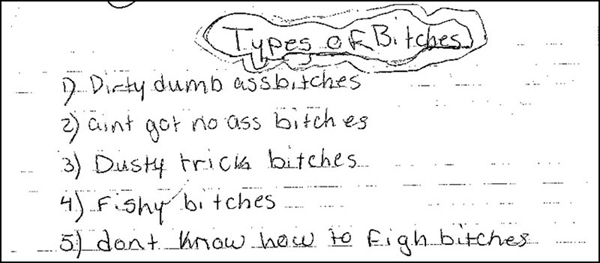
I was just directed to a hilarious post over at 'And I am Not Lying', called 'Types of Bitches', about a list written by third graders at an inner-city Washington DC school, detailing almost 100 types of bitches.

I'm blown away by the ingenuity of whoever wrote this. No way I could come up with that many types of bitches (or most things, for that matter) if I needed to. Clearly, these are kids who are absorbing a ton of language, and remembering it and recombining it at an impressive rate. I think we rarely see written examples of that.

But the real linguistic gem is the blogger's subsequent post, analyzing the comments people (presumably mostly adult, educated people) left on the original post. The blogger and some of the commenters he quotes really seem to get that a language prejudice issue arose out of this.
Stop being so judgemental. Damning her, her values, her upbringing, her likely future is ridiculous. She might be a “reflection of our future” but these are just a few sheets of paper not a manifesto or a clear indicator of a life rife with turmoil.
This is language practice -- a big part of what kids do with words is categorize, recombine -- test it out. It might tell us something about what the author hears a lot, but I don't think it tells us too much else about her. Certainly not that the "kid has issues", as one commenter put it. These are probably really powerful words in this kid's community -- words that let people exclude each other and seem better than each other, for example. What kid wouldn't want to play with that?

3.04.2010

The Language of Signs on Slate

Slate is running a really nice series of articles about signage this week.

Road signs are one of the, well, sign systems that got invented usage started, so I'm excited to see them examined in depth.

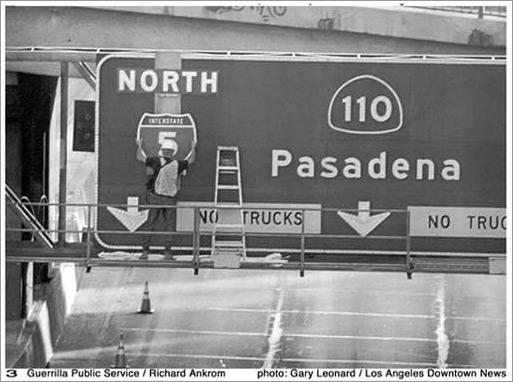
The first part in the series discusses the guy at left, who dressed up as a Caltrans worker and posted his own interstate sign because he was so fed up with the poor signage.

The second part provides an neat tour and analysis of what can go wrong in a poor sign system. I'm also looking forward to part four, about the informal maps we draw each other. These semiotic systems all fall under the heading of 'wayfinding', which is not just about making nice signs, but rather covers the whole science of how people will use signs to find their way. Wayfinding designers consider common use cases and other possible routes users might take -- a lot of the same steps user interface designers go through when planning a web site.

One of the most interesting things about linguistics and semiotics is the fact that people use language systems almost unconsciously (until the systems fail). That's the starting point of the Slate article ('They're the most useful thing you pay no attention to.'), so I'm already on board.

Thanks to Sonia for sending this over.

3.03.2010

Tomorrow is National Grammar Day

Not sure how excited to be about this, but I suppose, if invented usage celebrates any day, it should celebrate National Grammar Day.

It's certainly nice to see that the usage blog community is alive and well -- I found out via twitter about this grammar limerick contest.

I'm entertained enough that I will participate by pretending it's about cognitive grammar, and maybe grammatology, rather than the pedantic lack-of-error grammar and a celebration of cringes. I intend to have a grammartini, at the very least.

(Thanks to Maveric for the tip!)

Update: Unfortunately, his week is also National Procrastination Week, so grammar will have to wait.

12.18.2009

Prisencolinensinainciusol


"Prisencolinensinainciusol" is a song composed by Adriano Celentano, and performed by Celentano and Raffaella CarrĂ . It was first released as a single on November 3, 1972, later also on his album Nostalrock. The lyrics are pure gibberish, intended to sound like American English as heard by a non English-speaker. In an interview, Celentano explains that the song is about "incommunicability" because in modern times people are not able to communicate to each other anymore. He added the only word we need is "prisencolinensinainciusol" which is supposed to stand for "universal love." (from wikipedia)

12.15.2009

I'm a Mac (Smug) / I'm a PC (Stuffy)

Given the recent attention that Cristi has given to the Great Apple / Microsoft Ad War of 2009, I thought I'd call some attention to some ads that have escaped our Yankee eyes. No doubt, anyone with access to a television is keenly aware of the Mac vs. PC ads, the ones where Justin Long heaps steaming piles of smug on that unfortunate looking and woefully out of touch PC guy. What you may not have seen is how these ads were imported for the viewing pleasure of our friends from across the pond.

For those who haven't had a chance to see or have never heard of Peep Show, That Mitchell and Webb Look, or That Mitchell and Webb Situation, you should change that posthaste. The first season of Peep Show can be streamed on Hulu, the first season of That Mitchell and Webb Look can be streamed on Netflix, and That Mitchell and Webb Situation can be found on YouTube (along with the remainder of the other two series). These shows are without a doubt some of the finest comedy programs I've ever watched, and a clarion reminder of why the Brits do it so much better than we do (I'm sorry, but the American version of The Office is a waste of time, imho.) Anyway, when Apple decided to import the Mac vs. PC ads to the Queen's Country, they enlisted the help of David Mitchell and Robert Webb, who--you've probably guessed--created and starred in the above programs.

Like Oscar Wilde, George Bernard Shaw, or Winston Churchill said: America and Great Britain are two nations separated by a common language, and these ads when viewn through this lens change the tone of the ads quite a bit. They heighten the smug Mac / stuffy PC conflict to the point of ridiculousness, which has the effect, at least in my eyes, of invalidating the aim of the advertisements in the first place. Whereas they are supposed to be 'out with the old and in the with new' ads, they affect the tone of the cool kid in school making fun of sorry old Poindexter who is too wrapped up in his schoolwork to stop and smell the iFlowers.


Now, this brings me back to what Cristi was writing about with the populism of the Microsoft ads. Their recent ad where they give someone a thousand dollars to buy a computer was the most effective. While Macs may be slick, cool, easy on the eyes, and--I'm told--immune to viruses, they're still prohibitively expensive and not without their own shortcomings. If I were Microsoft's Don Draper, I'd produce a commercial where a Mac user fidgets with those oddly-designed AC Adapters that Apple makes attempting to plug it in at just the right angle so their MacBook Air will charge, gives up when they cannot accomplish this, calls tech support to find out that their AppleCare Warranty has expired, and then has to buy a new AC Adapter for 100 dollars which they will be given the option to have engraved. If that doesn't shatter Apples pretense of cool, I don't know what will. In short: To heck with Apples fashionability; all hail the rugged PC, as rugged as the hands of the proletariat.

And now for something completely different:

12.13.2009

Funnest. Usage. Ever.

In an interesting symmetry with my last post, the Montgomery Street BART station has been taken over by Mac ads. (Click pictures to enlarge.)

Specifically, they're iPod ads, and they are standard Mac white with bright images of the product being played with, and minimal text. In fact, the only text is either 'iPod Touch' or:

"The funnest iPod ever."

Maybe it's my pro-mac bias coming out, but I think this is a particularly pithy, appropriate and communicative Invented Usage.


Because it's the only text in all the ads throughout the station, we can't possibly think that 'funnest' is an error or is unconsidered. Further evidence that it is a conscious choice comes from the fact that it matches the content of the ads: 'funnest' is a fun word. At least, it's certainly more fun than 'most fun'.

I am generally a fan of language that does what it talks about, or imitates the experience it tries to convey. 'Funnest' is a nice clean example of this. Writing teachers are fond of saying, 'show; don't tell'. And 'funnest' does both in one word.

12.05.2009

All the Sudden, It's Windows 7

You've probably noticed that Microsoft is advertising Windows 7 very heavily -- posters from this campaign have taken over the Montgomery BART station in downtown San Francisco, where I go on the way to and from work every day. (Click pictures to enlarge.)


"I'm a PC" positions the PC as the computer of the people, and "Windows 7 was my idea" builds on that momentum. (Notice none of them have computers at all -- Windows is computers for non-computer people.) This whole campaign takes sort of 'everyman' approach it takes, which is reflected in the images and, of course, the language.


Which, to my mind, makes it even easier to forgive something like a less/fewer error:


"I told them it should require less steps. Now it requires less steps"

These are supposed to be everyday people, using spoken language -- I'm willing to call this a calculated decision by Microsoft's copywriters. (Even though the guy using 'require' doesn't seem to match with this level of casualness. But whatever.)

The same might go for these examples of hedging, which I find really funny:
"I said to make it effortless. They made it pretty effortless"

"I said, 'nice and simple.' And now? It's nicer. And simpler"

As I've written before, 'pretty' is just about as ambiguous as it gets, allowing readings from 'very effortless' to 'barely effortless'. And both of the above seem to generate a really strong implicature that Windows 7 is not completely nice and simple, and not totally effortless. If it really were totally nice and effortless, why would you not say so?

But the thing that really caught my attention was this Invented Usage:


Now, I'm fairly certain I've heard 'all the sudden' (as opposed to 'all of a sudden') before in spoken language, but it really struck me as odd here. For all the weirdness and informality of the campaign, it's certainly all in standard English.

It's not shown in the picture, but the person represented as the speaker of this quote is a middle-aged black man. I wondered if this was a nod toward African American Vernacular English, but haven't been able to find anything on line to support the idea that this is an AAVE idiom, or that it's associated with any other speech style in particular.

Of course, I did find the usual rants about how 'cringe-worthy' 'all the sudden' is:
http://www.englishforums.com/English/AllTheSudden/vhpgv/post.htm
http://www.antimoon.com/forum/t10482.htm
http://grammartips.homestead.com/sudden.html.

Most of my friends had the intuition that this usage was unprofessional and probably hurt the image of the campaign, since it might show sloppiness or lack of consideration. (Not to mention that the crux of the campaign is that people hated windows before, and got so upset that it finally changed... sigh.)

I think either the writer thought this was on the same level of informality as the rest of the campaign, or the writer (and copy editors, graphics people, etc.) didn't know the 'correct' version of the idiom. Either way, this seems like evidence that 'all the sudden' has come farther into the norm than I thought.

1.11.2009

invented usage and friends

first, i want to give a shout out to Jonathan and Lauren, who have been visiting San Francisco for a Linguistic Society of America conference this weekend. it's nice to be in the linguistics loop a bit, even if i'm not in the linguistics world.

Lauren works for a lab in Boston labeling noun phrases for a computer language-recognition project that sounds really interesting. (she's also the only current follower of invented usage!) Jonathan is in a joint PhD program at UCSD and San Diego state, where he specializes in sign language. He presented his first year paper at the conference this weekend. (On the schedule under 'Speech Planning and Signed Language Phonology')

second, Dave over at tubthump.blogspot.com has written about one of those everyday grammar foibles that we concern ourselves with here at invented usage:
I just saw a poster for Valkyrie, whose tagline is: "Many saw evil. They dared to stop it." I assume that the writers are using the common construction that typically goes "Many people talk about [some problem], but these people did something about it." The "but" and the emphasis on "these people" (or just "they") are critical because without them it's not obvious that the subject of the second clause is not the same as that of the first. Without this emphasis, one could read that the people who talked about the problem are also doing something about it, but the speaker is actually trying to contrast the two groups' responses. Moreover, I'd argue that this is the more common (and grammatically correct) reading.
Check out his full post here.

last, and probably least, i apologize for my long absence! i'm running a firefighter blog, The Kitchen Table, as part of my job now, which makes it hard to get motivated to blog when i get home. It's going pretty well and is worth a look-see!

10.01.2008

in memoriam: David Foster Wallace

in David Foster Wallace a great part of the american landscape of literature and language was lost. As an addendum to Scott's last post, i wanted to point out the ways DFW touched invented usage.

better than Dave Eggers

when we decided to book club on invented usage, our first (and so far, only) attempt was Dave Eggers's A Heartbreaking Work of Staggering Genius. i was still reeling from my first encounter with Wallace, Brief Interviews with Hideous Men, and those discussions showed it. in both part 1 and part 3, i really revealed how much he influenced all the reading i did afterward. if you'll permit me to quote myself...
and the thing that sets the gimmickry of ahwosg apart from that of, say, david foster wallace, is that eggers never turns the lens around. he never makes the reader speak to him, never comes out with 'the only access you have to these tragedies is what i'm choosing to tell you about it, and you can't trust me!'. (part 1)

i think that witty, po-mo, self-referentiality was, at one time, a very new idea. but now we've read david foster wallace and the whole new generation of writers that he and Eggers spawned, so i feel like the style has lost some freshness. (part 3)

for a certain genre of writing, DFW has informed, if not outright spoiled, innumerable readers of our generation.

death of a SNOOT
in the summer of 2006, i came across an article by DFW, Harper's Magazine: Tense Present, that i felt compelled, as a usage liberal, to engage with. the resulting post, the SNOOT fallacy, generated a lot more comments than average, and in turn compelled me to write one of my favorite posts, the deconstruction of a stradivarius.

it's an understatement to say i was surprised to find out that DFW was a SNOOT. really, it shook the core liberal values that have inspired this blog from the beginning. if a writer like DFW, who so clearly knows and respects the value of language, calls himself a SNOOT, maybe SNOOThood isn't as bad as i'd previously thought?

i stood my ground, obviously, and those posts explain why, but DFW was the most worthy SNOOT adversary i can imagine. that confrontation is a moment worth pointing out in the blog's history.

suicide the internet
DFW is called a postmodern writer for several reasons. not the least of these, i think, is his engagement with media in a lot of different forms. what little of his writing i've actually read involves characters who realize that their whole lives are built by text and so on. for me, he really brought home the ways in which we are surrounded (in some cases trapped) by the texts that surround us (writing and speech about us, by us, for us).

i'm not sure whether it's ironic or appropriate, then, that he's now the subject of an extensive online obituary. gawker's compilation points out the fact that DFW will now continue to reach out, via the internet -- from beyond the grave -- to new readers. mcsweeney's probably has THE example of this postmodern obit. their 'memories' page collects the eulogies of anyone and everyone who ever met DFW -- especially those who got kind notes from him -- so that seemingly every word he wrote is collected and instantly accessible.

but this new DFW is surrounded by his suicide. if his work was somewhat disquieting before, it will now be a road map into depression or an extended suicide note.

suicide presents all kinds of questions, and writings like DFW's provide lots of possible answers. i predict, the commentary (see all the comments on the links above) from readers will no longer be about our modern times or about technology, but about the man himself. and who knows whether he would have wanted that?

9.17.2008

Christ on a jet-ski, Hallie!

David Foster Wallace left us this past weekend, and the world is a much sadder place for it. I'd first heard his name when in high school, when my most beloved teacher, Ms. Wilson, recommended his magnum opus "Infinite Jest" to me. She knew that I might find the 1,100 page novel a bit daunting, and suggested--if I didn't have the nerve--that I might as well just pick up "Girl With Curious Hair."

It wasn't until after college, during the summer of '07, that I finally got up the nerve to tackle IJ with my girlfriend who would be reading it also. It took over our lives in a way only few things can, and we became both a source of irritation and envy for our friends. During that time, reading about Don Gately, Hal Incandenza, O.N.A.N., Eschaton, Wheelchair Assasins, Madame Psychosis, The Entertainment, the concavexity, etc etc, I kept thinking to myself that I wish I'd read it sooner. In it's pages I found a sensitivity to the modern condition that was at once critical and empowering, at once heartbreaking and hopeful.

In the days since DFW "eliminated his own map" (to borrow terminology from IJ), I've read tributes written by everyone from Patton Oswalt to Dave Eggers to Gawker commenters. It's surprising and heartening to see just how many people are affected by his loss. His genius was one of those rare types, so total and self assured as to take the form of a sheer force of nature. In no small sense, his gift was taken for granted, and, now that it is gone, his lack will leave a gaping hole in the literary consciousness that it is incumbent upon us to fill.

Christ on a jet-ski, Davie! We'll miss you.

9.14.2008

invented fraking usage


no sooner did i say (in my last post) that one person rarely, if ever, has the power to change language, than this lead comes out of AP:
What the 'frak'? Faux curse seeping into language
NEW YORK - Lee Goldberg thinks Glen A. Larson is a genius, and not because the prolific television writer and producer gave us "Knight Rider" and "B.J. and the Bear."

It was Larson who first used the faux curse word "frak" in the original "Battlestar Galactica." The word was mostly overlooked back in the '70s series but is working its way into popular vocabulary as SciFi's modern update winds down production. (full story here)

The article gives the same explanation for 'frak's 'virus-like' spread in culture as for its use on the show: "You can't get in trouble. It's a made-up word."

On Battlestar Galactica (or BSG to us cult members), 'frak' is everywhere. The plot centers on the military crew of the last battlestar in existence, which is about to be destroyed at any moment -- they're earthy, adult characters in a pretty fraking awful situation that merits a lot of cursing. In terms of usage, 'frak' is exactly equivalent to its 'real,' taboo counterpart. Characters accuse each other of fraking one another and they ask, 'What the frak?' I'm not totally sure, but I think they even call each other 'motherfrakers.'

While Larson, of the original series, claims he was trying to give the show an 'other-worldly' feel by using the made up word, it also clearly serves a really important purpose. I (and I assume a lot of viewers) was a bit turned off by it at first, but we definitely buy a made-up word more easily than we buy a bunch of soldiers who don't curse.

Language log has blogged quite a bit about what they call 'taboo avoidance,' especially at the New York Times and other media of record. But the frak of BSG is different for two notable reasons.

First, it's not in print. LL has chronicled a lot of attempts to orthographically represent curse words, like f***, f-bomb and #@!!*. But I'm unfamiliar with similar devices for the spoken word except saying "Starbuck here used an expletive."

Second, the NYT gets into trouble because the people it's quoting and reporting about curse. We all know the Times' motto, but some of the news isn't exactly fit to print. Larson and the other BSG writers, on the other hand, have no such task to accomplish. Their only obvious option was to write characters who didn't curse.

Exactly why 'frak' is ok by the FCC is another important question. One of the actors quoted by AP espouses a theory that it must actually be the sound of a word, not its meaning, that matters. But according to a recent appeals court ruling against the FCC, Bono's use of 'fucking' at the Golden Globe awards should not have merited a fine because "offensive language used as an insult rather than as a description of sexual or excretory activity or organs is not within the scope of the Commission's prohibition of indecent program content." (More on LawMeme.)

Though we started with the power of an individual, we return, as always, to the masses. Because 'frak' does not have the same history of usage as 'fuck,' it's not the same word. It doesn't carry the same associations as the really violent, angry instances of 'fuck' we've heard throughout our lives.

But the point of the AP article is that 'frak' is making its way into that spot in our vocabulary -- if only among the nerds. If this 'viral' propagation continues, and if 'frak' starts taking on those violent associations, maybe when they remake BSG in another 30 years, it will be just as taboo as 'fuck.' I've definitely caught a strain of the virus. I've never used it in anger, but I've cursed 'frak!' in my head a few times. I've also thought 'Gods damn it!' when the mood strikes.

(Thanks to Jamie for sending this one our way!)

6.25.2008

a manifesto and call for submissions

language is constantly changing. this truism has always been the foundation of this blog, but i wonder whether i've ever really written about it directly. language changes. i can't begin to think of a counter argument. who believes that it doesn't? even the most stalwart grammar nazis must admit, grudgingly, that language does change.

language changes according to some predictable patterns, some semantic, some syntactic, some phonetic. but it also changes according to the whims of inventing users, which are unpredictable to the same extent that human life and action is unpredictable.

sometimes the way language changes even changes. new technologies emerge that make new transformations possible, like typographic change. what it means for language to change changes. rules and norms can also change, allowing whole ranges of invented usages to emerge or gain legitimacy.

an invented usage is the leading edge that exposes a change in language. very rarely does any of them make a splash on its own, but they often indicate a certain change or even a change in the way change happens that can have far-reaching social, psychological, political or technological roots and implications.

invented usages also have effects beyond their meaning, beyond their connotation or denotation. they make us uncomfortable. they make us laugh or take each other more seriously or less seriously. they make some people angry.

'why?' is a question i've meant to address for a while. why does change in language affect us? i've arrived, of course, at my own answer. because that's what bloggers do.

language surrounds us like the whole world. we are born into it, we work with it our entire lives, and we pass out of it. and no one person can have any measure of control over it. only a handful can string together a single sentence that lasts for a decade. even fewer can actually change the language itself for any amount of time. who has the power to create and destroy words, or alter their meanings forever?

and yet, language changes. no wonder people who strive to perfect language are so frustrated when a mob they don't know, don't like, don't respect, and consider uneducated, change it effortlessly and without a second thought.

meanings, and our ability to express them, are precious. in fact, they're the ground we stand on. invented usages are the joining of things we never thought were the same; they're the tearing apart of one thing we thought shouldn't ever be broken.

Invented Usage tries to celebrate, or at least tolerate those changes in all their mechanisms and forms. though we all use language differently, i find some comfort in the fact that invented usages come into being because we all change it in similar ways. change ultimately takes place because we continue to make the same mistakes and innovations as people we've never met, the way channels form because drops repeatedly take the same path down a slope.

on Invented Usage, a manifesto and a call for submissions aren't incompatible, because invented usages come from everywhere.

so send in your invented usages, right to inventedusage@gmail.com. send in an invented usage, and i'll post about it. send in posts, and i'll post them. all my favorite blogs (photoshopdisasters.com, thingsyoungerthanmccain.com, do it this way. maybe, with the power of the internet, we can all be in this together.

5.07.2008

a pretty, preettty, pretttty invented usage

a german exchange student i hosted in high school asked me, "what does 'pretty' mean?"
"schoen," i said. "beautiful."
"but you just said, 'it's a pretty good movie,'" she said.
"oh! that pretty..." and i discovered i really couldn't define what i'd meant.

not only that -- i wasn't completely sure what i'd meant in the first place. did i like the movie "to a fair or moderate degree" as per the dictionary.com definition of "pretty"? did i really dislike it, but want to avoid conflict with someone who may have liked it a lot? did my inflection rise from high to higher on "pretty," indicating that i was surprisingly impressed with the film? which of these meanings is conveyed by which prosodic pattern?

i can find surprisingly little information on the usage of "pretty" on the internet aside from the above dictionary definition, which isn't that helpful. "fairly" and "moderately" don't really answer the most basic semantic question, when i say something was "pretty good," to what degree did i like it? more than a lot? less than a little? a moderate amount?

some friends and i brainstormed and came up with at least a half-dozen meanings of "pretty" depending on context and inflection. some of these seemed to be ironic plays on each other. normally these things are considered adaptations or inflections on some basic semantic meaning. But i'd argue that there is no use in starting with the "original" or "normal" meaning of "pretty." we must consider apparently "external" things like context and inflection from the beginning when studying meaning. (and anyway, even language log says...)

using some humorous examples, i'd like to argue that we often deliberately use pretty to hedge or be unclear -- or uncertain -- about our meaning.

consider one of the most famous users of "pretty," Larry David of Curb Your Enthusiasm. a number of times throughout the series he says things are "pretty pretty preeeettttty, pretty good. pretty good," at pretty awkward and inappropriate times. hilarity ensues.

here, he's renewing his wedding vows. at a time when he should be as enthusiastic as possible, he mitigates his positive feelings by saying his relationship with his pretty wife is "pretty good."


in this scene, he's talking to a young man about his new relationship. the ambiguity of "pretty" makes for a very awkward situation.


in another scene that i couldn't find on youTube, larry gets reamed out by a near-stranger in a most extreme way, but when his wife asks, "how did it go?" he says "pretty, preettyy, pretty good."

i think those scenes are funny precisely because no one knows exactly what he means by "pretty." emphasizing the word that seems to have little to no meaning on its own is absurd and pretty funny.

i usually write these kinds of posts in response to a claim by someone i disagree with. but i wasn't able to find any in this case. i'd like to issue a challenge to any one out there in blogo-land to come up with a useful, semantic, non-usage based definition of "pretty."

5.01.2008

Letter to Anheuser-Busch

Anheuser-Busch, Inc.

One Busch Place

St. Louis, MO 63118

May 1, 2008

To Whom It May Concern:

While enjoying one of your affordably priced, moderately quaffable beers the other day, I noticed Busch’s slogan. It read—and you’ll have to forgive my paraphrase—something along the lines of, “Refreshing as a mountain stream, smooth as its name.” With respect to the second clause, I couldn’t help but wonder if this is intended to be vaguely sexual? On the surface, it seems to indicate that “Busch” is a word that flows easily off the tongue. I think we both know that it is not. There may be something to say about the word’s sibilant conclusion, but the hard b and guttural u are anything but smooth. Personally, I think the phrase is suggestive of a certain part of the female anatomy that shares its name with your hops flavored brew. If this is the case, then I’d have to say that I believe your slogan is quite clever. If not, then I’d suggest changing it. Your marketing department, no doubt, can come up with something sexier or more ironic to slap on your cans. In fact, I might start there. Cans.

“Busch: We’ve got cans you can suck on all night long.”

Okay, maybe that’s a little weak, but you get the point. I’m not the person you pay ungodly sums of money to design your packaging.

All this nonsense aside, thank you for providing me and others with a thirty rack that can fuel any night of drunken depravity, and burden the next morning with the severest of hangovers.

Beer flavored regards,

Scott Kolp

4.02.2008

the slow rise of the plingular

now that i'm working in a writing/editing setting, at some moments i get to discuss usage professionally. sometimes this is particularly interesting, since the News Editor to my Editorial Assistant is British. recently, he caught a 'mistake' in an ad. it was the sentence,
that's a savings of over $400!
"shouldn't it be 'that's a saving,'?" he said, very reasonably. 'why, yes,' i said, 'it probably should. '

but it just isn't.

comparative google stats bear out my assertion: 124,000 hits for "that's a savings" vs. 59,000 hits for "that's a saving." it's apparently not done across the pond, though.

similarly, while we were debating the capitalization of the following headline:
Why Are Operations the Forgotten Part of Firefighting?
i asked, "shouldn't it be 'Why is Operations...'?" and, sure enough, our intuitions and the rest of the article agreed. (otherwise, wouldn't it have to be 'Why Are Operations the Forgotten Parts of Firefighting?) it doesn't sound right, either (maybe this is just in the firefighting speech community?) to say, "Why is Operation the Forgotten Part..." it's also surprisingly hard to find a good standard for capitalization, but that's a whole nother post.

so, what's going on then, eh? somehow 'operations' and 'savings,' which both have legitimate s-less singular versions, have migrated over into singular territory themselves.

it strikes me that both of these singular nouns are parts of a whole. when they're not used that way, we naturally revert to the plural verb forms. 'operations are going well,' 'savings are hard to come by,' but in the original cases given, they're specifically a single part of a whole -- either part of a price or part of firefighting.

however, that doesn't seem to be a 'reason,' per se, and it seems to take some repeated use for nouns to wear down into this pattern. evidence for the slow, uneven (even unmotivated?) erosion of usage: these aberrant singulars are particular to speech communities (Americans, Firefighters) and i have trouble coming up with novel examples. 'flowers is a forgotten part of romance,' doesn't seem right. maybe it's the suffixes? no... 'mastications is an important part of digestion' doesn't sound good, either.

i'd love to hear them if you have other examples of s-ending singulars. the only other one i can think of, interestingly, is 'news,' which was originally the plural form of 'newe,' meaning a new thing or tiding. but that word had been in this grammatical predicament since it was middle english.

3.11.2008

the prestige hierarchy of domain names

please slide your eyeballs on up to the top of your browser window and look at the url in your browser.

language in the realm of computers is particularly interesting because of its ability to command. one writes to a computer and, by doing so, actually acts. some liken this to the ancients' belief in the mystical power of language in the form of runes or charms.

the url is a particularly interesting example of computer language because it's not just words, or even just a command--it's both those instances of language, and a location as well.

everything between the http://and the next / is the name of/location of/directions to a particular website or server. after the /, each term is a directory or file. for instance, the website where i work runs a server machine called FireRescue1, which is our domain name. on that machine are folders corresponding to each of our topics: /products, /ems and so on.

as with any system of language, this one has a grammar that lets us understand the relationships of the parts. in many ways, they go from larger to smaller as you read from left to right, and the smaller parts are contained within the larger ones.

and of course, as in any system of language, even language that's seemingly written for machines, where there is hierarchy, there is prestige.

i recently laughed when a friend recently directed me to his old website, "phoenix web." "oh," I said, are you phoenixweb.com? and he said, "no, phoenix-web.us." and i was immediately struck by what a drop in prestige this was. similarly, this blog would be all the more professional if it were located at inuse.com. but of course, that kind of prestige costs money...

the basic idea for this post came, actually, from a woman's email address i saw: herfirstname@herhusband'slastname.com. would it ever be the other way around?

3.10.2008

Introducing The Interrationale

Another shameless blog plug: I have recently started a new blog as a creative outlet as well: The Interrationale.

Unfortunately, I don't think it is very accessible, at all, since it is essentially just place to put detailed research notes as I read up on some schools of thought that I didn't get to study in college.

The result is all the clarity and cohesiveness of Western Marxist social theory expressed in the vivid, dynamic idiom of analytic philosophy.

That said, I would treat it as a personal favor if anybody read and reacted to it. It actually is going to have a lot to do with language and rhetoric, since one of my main sources is Habermas' The Theory of Communicative Action.

Ultimately, one goal I have is to build to a rigorous answer to this question: how is computing and especially the internet communication changing society?