7.31.2006

deconstruction of a stradivarius

i already devoted a whole post to this article by David Foster Wallace, which appeared in Harper's. as satisfying as writing that was, there is one point, one essential metaphor of Wallace's text, that deserves even more attention.

writes wallace: "A fellow SNOOT I know likes to say that
listening to most people's English feels like watching somebody use a Stradivarius to pound nails."

a wildly descriptive analogy (isn't it?) that serves to illustrate wallace's SNOOTy outlook for the rest of the article. the analogy doesn't just characterize a snoot's logical position, but also the rhetorical and emotional impact of the 'mis'use of language. to introduce such a charged metaphor into what wallace considers a 'logical' argument is to already break down those distinctions (logical vs. rhetorical vs. emotional appeals) to which wallace clings so strongly.

consider the emotional impact of watching someone literally use a stradivarius to pound nails. one would be not only appalled but almost sickened, and certainly justified in trying to stop that clearly destructive action. that is, this use is not just misapplication of an instrument and an unsuccessful endeavor. it also causes the destruction of something finely-wrought by a long-dead master, which, had it been preserved, could have been used by someone else to produce something profoundly beautiful.

it takes a lot of training to properly use a violin, and even more to derive the full benefit of playing an instrument like a strad. there are those, one supposes, who appreciate the music but do not have the education necessary to produce it, but there are apparently others whose ignorance regarding the instrument reveals a ignorance to even the beauty of music.

a stradivarius is a fragile physical object with huge historical significance. to even have access to a strad means having extreme privilege and expertise. the number of such old violins is so limited that even professional recording artists must take excessive precautions when playing them. the VERY wealthy own strads. the poor pound nails.

a SNOOT is one who believes that the voice of an uneducated person is a detriment to language.
they believe that your 'mis'use of language is an infringement upon their ability to use language correctly--not just correctly, but sublimely.
they believe that language is an object that a community shares and should view as a valuable link to the past. if you 'mis'use it, it is significantly, violently and irreparably damaged.
they cannot write the poetry of Keats because you say 'ain't.'

i'm not sure how the idea that language can be damaged got started, but it's very old and often taken for granted. perhaps the snoots feel that the nail pounders should be given an instrument other than language--at least it would be well-applied to the kind of communication 'most people' engage in.

the metaphor, of course, carries intense classist and even racist undertones. the violin and the hammer might as well be symbols of stereotypical leisure and working class activities. the violin is the height of a certain kind of refinement--but only classical european refinement--the only kind that counts. the metaphor calls to mind a savage native trying to bootstrap up to his first use of tools while the european craftsman looks on, disgusted.

doubtless, the snoot utterer, being perfectly in control of language and very well-educated about the consequences of its 'mis'use, knew all this in advance and packed it into the metaphor in question to precisely reveal her own superiority. doubtless wallace quoted it for its concision at debasing those who don't use language as prescribed. kudos to them both. now that's an artful use of language.

7.27.2006

the SNOOT fallacy

at issue is this article by David Foster Wallace (who i typically like and agree with). it's quite lengthy but well worth the read; Wallace is a very interesting writer and the topic is the politics of usage and dictionary-making. what could be more at home here on invented usage? there's a lot here i'd like to talk about and argue with, but i'll try to focus.

the article, which appeared in Harper's, i believe, amounts to a glowing review of Bryan Garner's A Dictionary of Modern American Usage. true to form, though, Wallace also gives us all the backstory including the 'seamy underbelly' of lexicography: the descriptivist/precriptivist divide. descriptivists would like a dictionary to reflect language the way people actually use it, insofar as possible, while prescriptivists tend to believe that a dictionary should tell us what's right and how to use words properly. i found it somewhat surprising that Wallace himself comes down firmly on the prescriptive side, proudly calling himself a SNOOT. that's a nice, cute term for something i've called a 'grammar nazi' or a 'big fat jerk' elsewhere on this blog. i'm sure he has his reasons for capitalizing it (and for once mispelling it as 'SNOT,' i'd like to add).

his precious reasons. wallace, garner, and snoots of their ilk are fond of reasoning about language. and the basic premise of 99% of logical arguments about language is... drumroll please... "the purpose of language is communication." in fact, this maxim is taken so keenly for granted that it is embedded only in parentheticals on linguistics departments' webpages. (Brown's for instance: How does the function of language (to communicate) interact with its structure?) so of course wallace feels justified in defending at least the prescriptivist rules that aid 'clarity and precision.'

i'd like to submit (usage liberal that i am) that language has more purposes than just communication. i even believe it goes beyond wallace's observation that the diction/style/accent we use communicates something about us. language is used to confuse, to distract, to entertain, to kill time, to remember, to make art, to perform ceremonies, all of which could be considered communicative under my usually broad definition... but beyond even that, the ways people judge each other based on language use are PART OF LANGUAGE ITSELF. its purpose is also to divide, include, grade and judge. these functions determine who gets listened to, and in extreme cases, who gets listened to is a matter of life and death.

wallace quotes a snoot friend of his: "listening to most people's English feels like watching somebody use a Stradivarius to pound nails." this analogy reveals more than a few things about the prescriptivist (snoot) perspective. first, it reveals that they consider language an object. an object that we all approach the same way from the outside and use for a determined purpose. they believe there is a right function and a wrong function for language, that that function is essentially benign and beautiful. wallace acts as though prejudice, awkwardness, and judgmentality are faults of people, and not built into language in any way.

wallace writes,
These are tense linguistic times. Blame it on Heisenbergian Uncertainty or postmodern relativism or Image Over Substance or the ubiquity, of advertising and P.R. or the rise of Identity Politics or whatever you will — we live in an era of terrible preoccupation with presentation and interpretation. In rhetorical terms, certain long-held distinctions between the Ethical Appeal, Logical Appeal (= an argument's plausibility or soundness), and Pathetic Appeal (= an argument's emotional impact) have now pretty much collapsed — or rather the different sorts of Appeals now affect and are affected by one another in ways that make it almost impossible to advance an argument on "reason" alone.
and i'd like to object. postmodernism is NOT relativism, though this is a common misconception. postmodernism never says 'everything is the same. it doesn't matter how we speak because everything is as good as everything else.' it says 'the distinctions we make in language are arbitrary, but they have to be made. we have to make the choice to have an official academic language, or to read a certain text a certain way. it's just VERY important that we consider why (and from what cultural standpoint) we're making those decisions.' wallace's distinciton between different rhetorical strategies is an old one--one of the oldest, in fact. but language has never been transparent. there has never been a 'logical' argument that was not also rhetorical and emotional. EVERY statement that has content also has form and also has a speaker who speaks from a particular perspective and whose words therefore have a particular emotional impact. as soon as a word enters the language (or is uttered... not the same thing, i guess) it's encoded with information about the social and mental status of those who use it. logic never has been and never will be free of language.

wallace finally praises garner's dictionary of modern usage because garner himself seems not to speak from a normal human position.
It's like he's so bland he's barely there. E.g., as this reviewer was finishing the book's final entry, it struck me that I had no idea whether Bryan Garner was black or white, gay or straight, Democrat or Dittohead. What was even more striking was that I hadn't once wondered about any of this up to now; something about Garner's lexical persona kept me ever from asking where the guy was coming from or what particular agendas or ideologies were informing what he had admitted right up front were "value judgments."
that is, according to wallace, the perfect person to judge language is barely a person at all. garner lays bare his assumptions, but doesn't admit the sociocultural ground he makes them from (although i'll lay 20-to-1 he's white). this is perfection in scientific distance and objectivity. maybe it's a great way to write a text book, but it misses something fundamentally beautiful about what language is: inconsistent and ever-changing, as anything determined by everyone in the world all at once has to be.

7.25.2006

triangle battle!

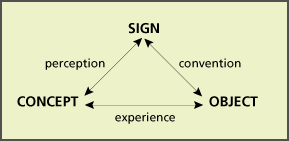
here's a version of the semiotic triangle from seb's last post:
it was made famous by ogden & richards in a 1923 book known as 'the meaning of meaning.' it's important to note that the line along the bottom is dashed and labeled 'an imputed relation,' since symbols can only refer to objects (referents, that which is referred to) through a concept or thought.

here's how ferdinand de saussure, writing slightly earlier, saw the relation between thought and language:
where A is the medium of thought (nebulous, undifferentiated), and B is the medium of language (undifferentiated sound material). the vertical lines are the arbitrary connections between the two media.

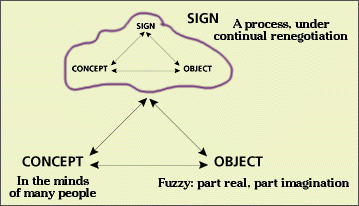
roland barthes, an interesting theorist who bridges the structuralist/post-structuralist gap in the mid-20th century, used this model: i personally like the more specific labels of the relations between the three vertices of the triangle. later, he turned to this image to explain the structure of the 'myth': here, the sign is a more complicated amalgam and the whole process of sign formation/understanding is recursive. (derrida, in particular, is known for his claims about the infinite play of signs and meanings).

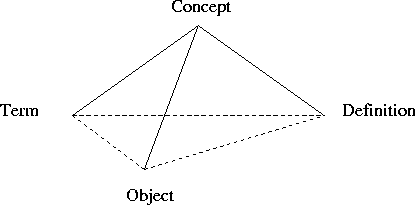
another more recent semiotic triangle is extended to include the term 'definition'. this one is from 1997 and is credited to Suonnuuti, who i've never heard of before. i guess the definition is added based on other conceptual systems or something like that.

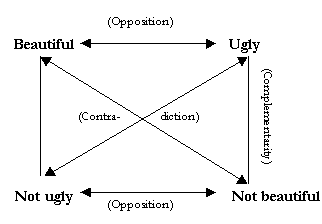
here's what i guess could be called a post-structuralist semiotic schema. it's greimas' semiotic square. it's not actually about the structure of a symbol, but the structure of a particular opposition within a text. remember, post-structuralism isn't a philosophy per se, it's just a way of handling texts and their meanings. in this example, the 'deconstructed' binary is 'beautiful/ugly', and the corners represent (more or less) different positions that characters in a story can occupy or represent.

and here's an epistemological model of the semiotic triangle that i think tries to explain what an artificial intelligence would have to have in order to understand signs: pretty, no? i don't really understand it, but it has the most lines, squiggles, and circles so far!

i guess the point is that these kinds of models are very vague. what lines and circles mean is pretty debatable and not even very empirically useful. also, the value of using a little picture to talk about symbols seems dubious at best to me. these kinds of diagrams only make sense when they're responding to one another, or when one philosopher says 'but what if it did work like this...' and uses an illustration to demonstrate their difference from some other tradition. someone should probably launch a study of these kinds of diagrams as a form in the semiotic/linguistic/cognitive fields. maybe someone already has...

7.17.2006

7.07.2006

this is awesome

A quick link:

http://www.secrettechnology.com/commercial/comvid.htm

More about this later after I have some time to putz around with it.

usage of the creek

Bonus! today's invented usage is actually a whole pattern of word formation!

when a friend of mine looked up some other word on urban dictionary, she stumbled across 'mugly,' and was immediately able to figure out its etymology. (we guessed 'mother-fucking ugly,' but the site also lists 'mad ugly,' 'monkey-ugly' and 'man ugly.') at any rate, these formations all have something in common. they all take the onset (first consonant sound or group of consonant sounds) of the first word in a pair and use it to replace the onset of the second word. fans of the movie Mean Girls also encountered this in the word 'fugly,' and if you can guess what that means, then i feel justified in saying that this is a productive morphological process!

it's interesting that in most of these cases, the word-formation combines the first letters of an adverb with the end of an adjective to form a new adjective. also, the 'adverb' in some of the cases i cited above is just a noun placed before the word. this too is a pretty slang-ish usage, i think, and i read it as 'adjective as a noun,' like 'ugly as a monkey.' it also seems possible to derive a new noun by combining an adjective and noun in the same way.

some examples that i found on urban dictionary:
foned
flunt
fex (pretty much any consonant followed by -ex is a word, whether by this formation process or not)
croned
grunjin
fimp
mex (the first definition at least)
fexy
grungry
mussy/mangina
fangsta
it's amazing what we have words for. (though more than a few of these did not mean what i expected them to.) a couple use additional morphological processes (changing vowel sounds, inserting another consonant after the onset...) but seem to be based on the main one we're talking about here. also, note that many of them have alternate definitions; for instance, i'm not sure 'f' can be considered a true morpheme since it has multiple meanings ('fake,' 'fucking,' 'female').

another key example is 'crunk,' a term made popular by rap producer lil jon (thank you urbandictionary). i always thought it was an adjective meaning 'crazy drunk,' since it has similar distribution distribution to 'drunk.' but, as evidenced by the contention on urban dictionary, the word has beaucoup de ambiguity. whereas 'drunk' (almost) exclusively applies to people, one can go to a 'crunk party,' and some claim there is a genre of music by the same name. there are also claims circulating that 'crunk' is a mix of 'chronic' and 'drunk,' and means to use alcohol and marijuana at the same time.

despite these ambiguities and alternate definitions, it's important to note that upon being introduced to a novel word a speaker of english slang can propose a systematic formation process. after hearing any one of these words we can create infinitely many more, whether we know the 'true meaning' or 'actual' formation process of the original example or not. after all, one example does not a pattern make. that is, it's possible that a morphological process actually becomes systematic for the first time when we try to come up with a coherent explanation for how morphology relates to meaning and then use the process (which the hearer has imagined!) to create more words. it's just possible.

6.28.2006

a tomato is a vegetable

such a vegetable, in fact, that people frequently have to remind each other that it's 'actually' a fruit. these are often the same people who like to correct grammar mistakes in conversation:
Me and Bob are going to add some tomatoes and other vegetables to the pasta.

You know tomato is actually a fruit. And I think you mean 'Bob and I.'

Oh, then you must not have meant to start a sentence with a conjunction just now...

anyway. we can tell that the tomato IS a vegetable because that fact organizes things physically in the world. for example:
1. the produce aisle.
2. the garden patch.
3. the hamburger. ask a friend: "have you ever tried fruit on your hamburger? it's actually great..."
4. it tastes like a vegetable, whatever that means.
and so on.

that is, the 'technical' definitions of a fruit ('the sweet and fleshy product of a tree or other plant that contains seed and can be eaten as food') and a vegetable ('edible part of a plant cultivated for food', thank you dictionary.com) are useful in some speech communities: scientific, botanical; but are incomplete and unable to explain certain facts about the physical tomato (it goes in the vegetable section of the supermarket). nevermind for the moment that 'vegetable' seems to include 'fruit' under these definitions. i'm fairly sure that in most speech settings they're a binary. enough to make the point, at least.

Scott gets credit for the observation that 'fruit' is by far the privileged side of the 'fruit'/'vegetable' binary. consider calling a person a 'fruit;' this is either a derrogative term for a homosexual man (but not nearly as offensive as some other words) or just a goofy person. calling someone a 'vegetable,' on the other hand, is an offensive way of saying that they are literally comatose or brain-dead, or a very offensive way of saying that they are a 'couch potato.' consider the brave tomato, following its instincts in spite of confusion from humans and jeers from the other fruits.

the Essentialist school of philosophy (and philosophy of language), which claims that any specific type of entity can be defined as a class such that every member of that class must share some finite list of characteristics (thank you wikipedia), would have a hard time with the tomato. poor confused tomato. it seems trivial, but figures like the tomato, which straddle two or more categories, have major implications in certain fields: the weeks-old fetus - human or not? the transgendered person - male or female? meaning - inside or outside of language? the answers to these questions are essentially decided by the usage of the terms, which can never be completely controlled by dictionaries, laws or experimentation.

calling 'a tomato is a vegetable' a category error means several things. it means you rely on a certain scientific and physical definition to determine the 'actual' 'real' 'true' category of an object. it also means you believe much of the world is often making errors by not adhering to that standard definition. it might also mean you think that everything definitively fits in one category or the other, and that this category can be determined (a transsexual IS actually male or female, a fetus actually begins living at a particular instant) as long as you have enough physical evidence.

and, while that isn't necessarily bad, it does, like the questioning tomato, make me slightly uncomfortable.

6.21.2006

viewn as viewn from above

Well, it turns out I'm not cloud nutzo after all. A quick scan of google hits for "viewn" revealed that there are other speakers/writers out there who ride the 'viewn' train.

Take this website for example. You'll see a lovely picture and a usage of "viewn". Now, what's interesting to note in this example is that the usage appears to be from a native german english speaker (note the ".de" extension on the URL).

Also, I'm no expert computer programmer, but you'll notice if you check out the search results that many of the URL extensions contain a "viewn" modifier such as the one in the URL above.

http://www.google.com/search?q=viewn&hl=en&lr=&safe...


Maybe someone more adept at programming could enlighten us, but I suspect it's actually "viewn" and not, say, "view N".

The moderater on this board (which seems to have something to do with an internet radio station) demonstrates what I'd conjecture is the most common usage of "viewn".

Under no circumstances should this station be viewn as an opportunity to go off on a tangent and play only things you like.


"Viewn" amounts to basically a passive form of "view" and the two seem function as a pair much like "see/seen", "show/shown", "tear/torn" "grow/grown" or "shear/shorn". In an impromtu test of my roommates just now, I asked them to construct a sentence in the passive voice using to verb "to view" that functioned as a caption that explain what on was looking at in a picture of the Empire State Building from the top of the World Trade Center. One roommate didn't react at all, but the other said "you want me to say viewn, but I know that's not right."

Interesting! Here is one other potential candidates for the "viewn" treatment (unforunately the only one I can think of):

Shoon (Shoo) - "The rat was shoon from the house."

Can you think of any more?

6.20.2006

some internet 'walla'

(Note made some slight alterations and additions since first posting -SK)

By which I mean background chatter, like the chatter Al Qaida is so fond of. To diverge for a minute and if you'll make this leap with me, the chatter is part of the world wide 'walla' or at the very least a large portion of the US's 'walla'. Background noise is so important especially in a culture fueled by the notion/infatuation with/realization of conspiracy (JFK / Da Vinci Code / Enron). There is certainly a feeling, which is hard to avoid, that the surface of things is only the record needle reacting to the minute shifts of the vinyl, the noise below it. In this metaphor, it appears there is something to be said about the distinctions drawn between speech and writing. Although, I'll save this (mostly) for another time, it's my belief that a conspiracy weary culture privileges writing and the text. Conspiracy makes us question the body and the words that come out of the body's mouth. The Smoking Gun demonstrates this. It has celebrity mug shots to reveal the falseness of the rich and famous' appearance in photographs, television and movies. Then it features documents to reveal the men and women behind the mask, in all the full figured infamy. Bill O'Rielly knows this well. We know how these public figures are to be viewed, but the website asks us to look at the 'walla' of their lives so that we might see the flaw in their design. In some ways, the entertianment provided by this unmasking supplants the entertainment that these people have dedicated their lives too. It's more interesting to read about O'Rielly's penchant for Loofahs then it is to watch him enter his chaotic No Spin Zone. I'll concede that the ins and outs of Lindsay Lohan's drug addictions and paternal strife are eminently more fun than "Herbie: Fully Loaded".

Now, I digress. In writing the above, I realized that I was being dogged by a phantom word. When I was writing:
We know how these public figures are to be viewed,

I kept wanting to write:
We know how these public figures are to be viewn

"Viewn" as is a modification of 'view' that rhymes (mostly) with "loon". Now maybe I'm going cloud nutzo over here, but do people actually say "vyoon", as in "The report on North Korean was vyoon by the President and his cabinet"? I really think they do and I believe I have and will. Someone should fax a memo to Hollywood to makes sure people are using this in their 'walla'. Without it the 'walla' in Hollywood restaurant scenes might seem as bogus as ray shields or GENERAL GREEEEVOUS in Revenge of the Sith. What do they use for 'walla' in those movies, by the way, just gibberish???

This brings me to my last and final point, the one I actually started this post for. I wanted to encourage you all to check out the blog for the Electronic Writing Course I finished only a month ago. The Prof has been so kind as to provide links to all of the final and midterm projects that people produced (minus a few that weren't internet friendly). Some are, no doubt, more successful than others. My personal favorites are:

"What We Want": A mash up of the NY Times and Craigslist.

and

"30 Poems": A poem with a very inventive and mysterious navigation method.

I've already pushed mine on you all, so I won't do so again. But... THEY'RE COOL! More later.

6.16.2006

usage of the walla

getting a head-start on planning my fourth-of-july menu, i looked up 'deviled eggs' (or is it 'devilled'?) on Cooks.com today, and i found a recipe that ended with this gem of an invented usage:
Walla - deviled eggs!
recipes on cooks.com are submitted by individual cooks, and 'walla' is certainly an easy leap from the american pronunciation of the french-loaned 'voila' - a pretty good phonetic transcription. of course, the problem with this kind of linguistic research is that it's impossible to know whether the writer was using the utterance jokingly or believed there was a word spelled 'walla.' an email client known as 'walla!mail' may be playing on exactly this confusion.

the linguistic purists over at urban dictionary have added their fiddy cent as well, listing it as slang from Arabic, Australia, and as a word meaning a stupid person. they've also already hit on the cooks.com usage:
""Walla" is a word used by ignorant people (particularly Americans) who simply don't know any better."
and from a particularly intolerant poster:
"Being stupid Americans though, they can't pronounce anything which doesn't sound 100% English (not that they can pronounce English either) so in their incredibly lazy way, they don't even try to pronounce it correctly."
they don't mention anything about the creative (and phonetically accurate!) orthography except to note that it's the result of a 'lazy' pronunciation... because writing is necessarily parasitic on spoken language, and old language is best language, and france is better than america in every way, and people who change language without realizing it are clearly inferior, and.....

but you invented users know that almost everything IS already a word. a cooks.com search for 'walla' revealed that there is a type of onion known as 'Walla Walla' or 'Walla Walla Sweets,' (assumedly named for the town) but didn't yield any more instances of the emphatic 'Walla!' (this search may also only hit the ingredients list now that i think of it.)

a google of 'walla' produces 26.1 million hits, overwhelmingly in favor of Walla Walla, Washington (a great name to begin with) and associated universities, onions, vintners...

filmsound.org also tells us that 'walla' is a standard term in the sound effects industry for crowd chatter.
"The word walla was created in the old radio days when they needed the sound of a crowd in the background. They found if several people simply repeated "walla, walla, walla, walla" it sounded like people talking."
and of course, it's now an adjective too:
"Today the walla group use real words and real conversations. The walla actors come prepared. They ... have researched the local jargon and geography so that the background dialogue will be authentic. Group walla has to be cut very skillfully like sound effects so that it does not sound artificially placed."

if there's one thing i can't stand, it's improper walla.

6.09.2006

sentence complexity

let me briefly and profusely apologize for our extended absence. the last month or so has been filled with vacations, moving, job hunts, comments on my last post, and so on. enough with this 'sorry' blather! on to language...

speaking of jobs, i'm spending the summer as a research assistant in a cog sci lab. i'm helping write/assess a government adult literacy and vocabulary test. that's right! i'm one of those people that makes standardized tests! i think there was a point in my life when i thought it would be an interesting career... i wasn't totally wrong.

so far i've written 20 questions. each focuses on one word with multiple meanings (usually including more than one part of speech). i write three fill-in-the-blank sentences that would make sense with the target word in the blank, and then i write three 'matching' sentences that would NOT make sense with the target word in the blank. but in all cases, the wrong sentences have to match in missing part of speech and all the sentences have to use the same form of the word (that is, no plurals or past-tense or suchwhat).

now i'm collecting a wide range of statistics on each possible answer sentence so that we can make sure, for example, that the wrong answers aren't systematically different from the right answers.

i'm running each sentence and all the sentences for each question together through a readability statistics website that gives me the Flesch-Kincaid reading ease, grade level, Gunning-Fog index, and average number of syllables per word.

i'm also taking a list of statistics about what i'm calling the 'syntactic complexity' of each sentence. these include number of prepositional phrases, number of strings of modifiers, number of non-main clauses and so on. it would be really interesting if any of these statistics ended up correlating with the response time we will empirically collect for the sentences.

interestingly, since the standard readability tests are partially based on the average number of syllables per word, lots of grammatical words (prepositions, quantifiers, conjunctions, etc) tend to yield low Flesch-Kincaid grade levels, but tend to make my 'syntactic complexity' score very high. this type of complexity also correlates better with sentence length than the readability stats do, since you can't have a syntactically complex sentence that's only four words.

no real conclusions to draw yet, except to say that a lot of these grammatical categories are tough to define, and sometimes come down to my research-assitant judgement.

if anyone out there in linguo-blog land knows of any official measure of syntactic complexity or any measure that's been used to predict reading times, send it on in!

5.15.2006

quantum language theory

since handing in my paper for 'metaphor and thought' today, i've been able to finally formulate my own metaphor for the great divide in the philosophy of language that's been bouncing around in my head since i watched that 'elegant universe' documentary.

first there was the newtonian theory of physics, which was fairly over-simplified and deterministic. then (to over-simplify a bit myself), along came albert einstein and came up with a much better theory that explained a lot more phenomena and required a major shift in everyone's thinking about the universe. einstein was pretty smart, but toward the end of his life when people started to talk about quantum mechanics, he couldn't handle it. 'gott würfelt nicht,' he said, meaning, 'god doesn't play dice, the laws of nature aren't based on probabilities.'

this is the same position analytic philosophers are in. (i think it's a nice metaphor for them too... they get to be einstein!). they cannot believe there is not a truth 'out there' in the universe to be discovered (i think a lot of philosophers might consider themselves atheists, but i'm just saying... gott might würfle). Their theories work a lot better than older classical models of language, but just try telling a philosopher that reference isn't deterministic, that language doesn't have to have a strict dependence on the world, that the odds determining how a word is used depend on the odds that another word was used two weeks ago and so on..., that vagueness isn't a problem that needs to be solved. you'll get a funny look and a bad grade.

now imagine a contemporary university physics professor who not only doesn't teach quantum physics, but doesn't believe in it. if you told them that light is both a particle and a wave (a very post-structuralist move, by the way!), they would give you a funny look and a bad grade, but then they also might get fired for being 50 years behind the times (unless they had tenure, in which case they might just be ridiculed in the literature and discussed angrily in the cafeteria and department meetings... i don't know how these things work.)

granted, from my understanding, there are more outlandish theories out there (like string theory) that aren't widely accepted or taught in most physics courses. to continue the analogy, i'm not saying philosophy classes should start teaching all the craziest semiotics they can get their hands on. i'm also not saying there's no value to studying analytic philosophy. it's smart, it's interesting, and it maps out a lot of the territory of philosophy of language and shows where the problems are. i'm just saying that philosophy departments and classes exclude out of hand, for no apparent reason other than the fact that it would force them to rethink 100 years of their own research, a huge branch of thought about the same questions they claim to be asking.

some quest for knowledge, huh?

5.12.2006

New Version of the Keats Machine

Hey folks! I've got a new version of the keats machine online for you to try. This one uses the entire poem as its word bank, and allows you to create your own poems with the scrambled lines. It's still not 100% done, but it's probably 75-80.

Please, go on and check it out, and leave your comments here.

The New Keats Machine

(It's the 2nd link from the top)

5.09.2006

Seconded

I would like to formally second cristi's post about our birthday. It's awesome! One year and 106 posts later... Just genius!

We love you guys. Keep reading and we'll keep writing. Actually, if you stopped reading we'd probably keep writing anyway.

To Invented Usage and blog for all seasons and a waste of time for all reasons!

happy birthday to us!

laughing in the face of the ridiculously high blog infant mortality rate, Invented Usage is celebrating its first birthday today!

we'd like to thank our approximately 11 faithful readers and 20 daily random readers who've given us the motivation to keep going through midterms, finals, writers block and many other obstacles that keep lesser blogs down.

in addition, we invite you to visit our May 2005 archives and remember the days when Scott and I were scratching out a foothold for the current dynasty and posting almost every day--sometimes twice a day! May 2005 is a classic vintage; it's got fights we picked with older and more qualified bloggers, prose poetry, the original 'like' posts, the conversation that led to our name in the first place, and a link to kittenwars.com. worth a look, indeed!

thank you again! please commence the singing of 'the birthday song' loudly into your screens at 20:00 EST, 5/9/06.

5.06.2006

semantics and the body

I LOVE this book. Semantics and the Body by Horst Ruthrof is the missing link between post-structuralism and linguistics that I've been waiting for.

The author briefly summarizes the history of philosophy of language before really delving into the nitty-gritty of why traditional formal semantics can't handle essential things like negation and metaphor. It's clear he knows his stuff.

While he doesn't buy post-structuralism hook, line and sinker, he does make an important move that is clearly based on literary theory. Instead of beginning with 'normal' language or 'positive' statements and considering meatphor and negation as marginal phenomena that can be described later (as linguists do), he begins with these as things a philosophy of language must account for, and goes on from there.

Ruthrof does buy the claim that everything is textual. That is, in opposition to Lakoff et al., he doesn't think there's some realm of unmediated physical experience that we code into language via metaphor. He believes the body has an essential place in a theory of language because it is a mechanism for interacting with and encoding various perceptual sign systems. It is these non-verbal modes of signification that make ALL linguistic expressions meaningful.

Metaphor, then, simply highlights the play (and the slippage) between the various systems. There is a continuum from metaphor to literal speech that we must negotiate (with varying degrees of uncertainty) every day. This is a pretty elegant theory. It buys a lot of things (for example) a theory of metaphor that meshes with a theory of literal language, without a lot of the explanatory baggage that Lakoff needs to pull along (does each individual's experience shape their metaphorical domains? what is the role of historical change in moving from 'live' to 'dead' metaphors?).

Pay attention, philosophers of language: these divisions (literal/figurative; live/dead; negative/positive) are not as clear cut as formalism would like them to be. Admitting that is the first step toward getting help.

4.27.2006

Another Project

I've started working on another flash project. It's called "The Keats Machine". Simply, it's a slot machine whose jackpot is "truth is beauty, beauty truth"... However, it's an unlikely jackpot, and the other combinations of words it comes up with are bizarre and, potentially, more fun to discover.

So, if you have the time, go take a look at it. It's still very rough, and I'm probably going to redesign it soon. I'd appreciate any feedback someone reading this might have to offer.

Click on "Keats Machine" to CHECK IT OUT!

4.25.2006

know his priorities Yoda does

today in syntax, we began talking about 'extraction,' a process for moving parts of sentences out of lower clauses and (in the pertinent case) to the beginning. this is known as 'topicalization.' it's used in certain instances of discourse to signify the centrality of a certain part of the sentence:
'he promised to fly'
'fly he did!'
here 'fly' has been moved from its normal position at the end of the sentence for emphasis.

this technique is also effective to demonstrate contrast:
'did he go to the store?'
'went to the MOON he did.'
this time a whole verb phrase has been moved to emphasize the contrast between 'store' and 'moon'

these are pretty believable example sentences, but for the most part the professor just sounded like Yoda all class period. and then it struck me: a while back there was a thread in several of the linguistics blogs about why Yoda talks so funny.

Eric Bakovic at Language Log 'lumps' Yoda together with all the fanciful Lucas characters and provides a breakdown of who can understand whom in the Star Wars universe. He claims that because it takes longer for us to decipher Yoda-speak, we think he must be smarter than other characters.

Eric Lippert cites another well-known use of linguistic tom-foolery in fantasy: Tolkien. He believes that Yoda is written to sound ancient, the same way as Tolkien's elves. Comments discuss whether Yoda is supposed to be German or Japanese. Neither seems right.

I know there's more out there than this, but I'll leave you with the most syntax-heavy (but still requiring little to no background) of the bunch:
Geoffrey K. Pullum, also at Language Log explores the fact that Yoda sometimes nails English syntax perfectly. Other times he extracts the object and places it first (leading many to comment that he speaks in Object-Subject-Verb word order--unnatural if anything is!), and other times he extracts a verb, adjective or verb phrase. Pullum concludes that this variety simply reflects the fact that Yoda is an alien and might not have learned English very well.

But I think that confusion sounds pretty familiar. It sounds just like topicalization! It doesn't slow down comprehension too much, and anyone who's seen a Star Wars movie can mimic Yoda pretty well without too much thought.

I believe Yoda sounds wise because he puts the most important part of his thought first. He knows what's critical. He saves his breath in general, speaking mostly in short declarative sentences. Additionally, he's a great teacher, and he knows how to make Luke focus on only what is important. All great reasons to topicalize your sentences.

Yoda sentence insert here!!

4.22.2006

Son of 'On Like Usage'

Once upon a time, I posted this classic: On Like Usage, which briefly shot Invented Usage to the top of search engine results everywhere and sparked a most interesting debate about the meaning and usage of "like."

As I draw close to the conclusion of my first actual syntax class, I have a few more tools with which to discuss 'like' and why it illustrates a challenge to the contemporary study of linguistics.

Categorial Grammar (CG) operates on the assumption that we can tell what type of word we're dealing with by where it's found in relation to other words. That is to say, we know 'ran' is a certain type of verb because it follows a noun phrase and provides a sentence. Another way to think of these relationships is as input-output functions. 'Gave' requires three noun phrases as inputs, and then provides a sentence (or, more accurately, a truth value) as output.

in the post linked above, I illustrated the myriad ways 'like' can be distributed throughout a sentence. it can modify nouns, adjectives prepositions, verbs... pretty much anything, now that i think of it. most linguists probably wouldn't consider this a problem, since they would claim that 'like' does not contribute to truth conditions. that is, that 'she went to the store' and 'she went, like, to the store' are true in exactly the same instances. if that's the case, 'like' doesn't contribute any meaning, and doesn't have to be accounted for in the grammar. linguistics adheres to a strict separation between language as a formal system (which syntax can describe) and language as it is used by people.

but 'like' DOES change the meaning, and in some cases the truth conditions (i don't believe they're the same thing) of sentences. it's one of many reasons why I think language use cannot be separated from language itself.

while syntax is interesting as an attempt to understand the patterns that arise from language use, the way it is actually implemented seems to forget that purpose. all linguists can do, at this point, is describe (to a limited degree) an idealized language that no one actually speaks.

4.11.2006

check this out!

After much work last week, my flash project is finished. If you want to take a look it's pretty simple. A grid of letters each containing a sound. Two words per grid spot forming words reading left to right and top to bottom.

THE PROJECT

PLEASE! Leave me comments and let me know what you think.