Showing posts with label error. Show all posts

3.04.2010

The Language of Signs on Slate

Slate is running a really nice series of articles about signage this week.

Road signs are one of the, well, sign systems that got invented usage started, so I'm excited to see them examined in depth.

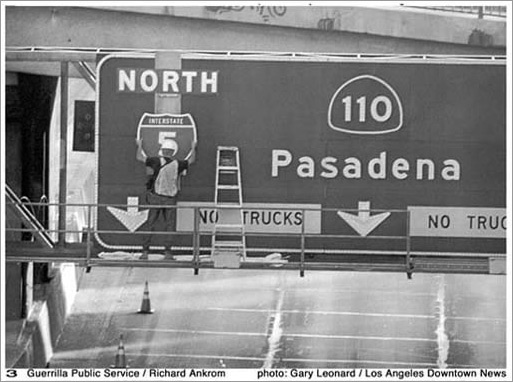
The first part in the series discusses the guy at left, who dressed up as a Caltrans worker and posted his own interstate sign because he was so fed up with the poor signage.

The second part provides an neat tour and analysis of what can go wrong in a poor sign system. I'm also looking forward to part four, about the informal maps we draw each other. These semiotic systems all fall under the heading of 'wayfinding', which is not just about making nice signs, but rather covers the whole science of how people will use signs to find their way. Wayfinding designers consider common use cases and other possible routes users might take -- a lot of the same steps user interface designers go through when planning a web site.

One of the most interesting things about linguistics and semiotics is the fact that people use language systems almost unconsciously (until the systems fail). That's the starting point of the Slate article ('They're the most useful thing you pay no attention to.'), so I'm already on board.

Thanks to Sonia for sending this over.

12.02.2007

go sok!

I've sort of buried the hatchet. There's at least one reasonable prescriptivist out there, and she blogs here: Red Pen, Inc. I feel like I've got an evil twin. It's a cute, snarkily written blogspot website with a home-made, annotated banner. But she consistently uses capitalization. (I have too, for the last few posts. More on that later.) We exchanged a nice series of emails regarding this post, but it's this one, about the Red Sox, that I want to take issue with.

Leave aside for the moment that she's a Yankees fan, though that explains some of her added grammar-nazi ire. Leave aside the fact that Scott has found that blogging about the Red Sox drastically increases your hit count, though that partly explains this post and completely explains this parenthetical (Big Pappi David Ortiz, Manny Ramirez, Jason Varitek, 2007 World Series Champs).

For now, let's just consider how angry she is about this error:
Curt Schilling will remain a Red Sox.
She's really angry. Notice, I don't disagree that it's an error. If it were Derek Cheater, he would be remaining a Damn Yankee, not a Damn Yankees. But the correction that she suggests is, "Curt Schilling will remain a Red Sock," which strikes me as preposterous.

Now, the 'Sox' spelling is presumably a phonetic adaptation of the common noun 'socks.' 'X,' god knows why, makes the same sound as 'ks,' or, it's often spelled, 'cks.' But I don't think we should assume that we can subtract sounds the same way we subtract letters to go from plural to singular. Clearly, when the Sox instituted their invented spelling, they should have determined and publicized the preferred singular. They're not perfect, after all.

But I think we should embrace the haphazard, happy-go-lucky, Manny-being-Manny ethos of the Sox. Let's make Johnathan Papelbon a 'Red Sok.' Let's admit to our phonetic natures and do away with the stodgy, old English 'c.' I've only found one web site that uses this, but it looks fairly high-level, and it doesn't mention the use at all, it just does it, as though it had done it before. All the other first-page hits seem to use 'Red Sok' as the plural. Get out your Red Pen... even I don't understand that one.

11.09.2007

what's in a whole nother error?

so, in my last post, i discussed the two definitions of error: grammatical or usage error ('spicket' for 'spigot') and technical speech errors ('cattleships and bruisers' for 'battleships and cruisers'). i'd like to address another, somewhat related, error issue that sprung from my thesis project on typos.

speech errors follow very predictable patterns. they are totally constrained by certain rules such as 'vowels only slip with vowels' and 'speech errors only produce valid syllables.' that is, 'bad' would never slip and become 'abd' because this involves a consonant/vowel swap and produces a sound combination, 'bd,' that doesn't occur in english.

clearly, typos don't obey these rules. the common typo the-->hte is a good example. 'ht' is not a valid word beginning, and yet this typo occurs all the time. most of the typos that violate the rules of speech errors have pretty clear motivations. 'hte' involves switching two adjacent letters. 'tghis' involves accidentally hitting a key next to the intended one. but in my thesis, i found a lot of typos that seem unmotivated by physical factors of the keyboard. for instance, someone substituted a 'b' for a 'p' and one typed 'soom bo-' when they meant to type 'some books.'

similarity of units has always been acknowledged as a factor in speech errors. each speech sound has a set of features (place of articulation in the mouth, manner of articulation, and whether or not the vocal chords are vibrating), and the more features two sounds share, the more likely they are to slip with one another. 'b' for 'p' makes sense as a speech error because the two sounds share every feature except voicing. but as a typo, it's hard to understand because the two letters are so far apart on the keyboard.

so it seems that there are some typos that obey the speech error constraints and are based on phonetic similarity. but some are based only on motoric or articulatory similarity. this has a couple of implications, i believe.

first, it seems to indicate that we do use inner speech when we type. the sounds of language play a role in the way we plan our typing, which doesn't involve sound in any other way. second, it means that we're able to separate articulatory features from phonetic features. this makes the comparison to speech kind of tricky, because in speech, the notions of articulatory and phonological similarity are the same. that is, phonological similarity is based on the physical characteristics of a particular medium--the human mouth we all share. it's as much an historical accident as they layout of the keyboard!

AND i have a completely unfounded theory! another thing happens in speech because of articulatory factors: transformations in quick speech. these are things like 'did you eat?' becoming 'jeet?' linguists don't consider these errors, in part because they're very predictable. so what if these kinds of abbreviations--which, remember, occur because of fast articulation--were analogous to articulatory errors (those caused by the layout of the keyboard) in typing? these kind of errors are, almost certainly, more common in fast typing and, if collapses aren't counted as errors, typing errors vastly outnumber speech errors. i'm not saying the numbers shold match perfectly, but the difference in frequency i found was really huge, and when i compared speech errors only to speech-error like typos, the numbers were quite similar. (sorry i'm being too lazy to actually haul out my thesis and give you the exact numbers. i'll send you a copy if you want one.)

i think the only real difference between articlatory laziness in speech and typing errors is that the former is completely expected. it's only in recent years that typing has become a real-time communications medium, and i would guess that we'll start to see more of these typos going uncorrected. i've certainly noticed that i tend to not correct them in informal im conversations, especially if they're fairly predictable and don't disrupt interpretation, like how-->hwo.

it's also interesting to note that almost all the definitions of error that we've encountered involve accidental violation of the speaker's intention. and these articulatory foibles certainly fit that bill. few people would think they meant to say 'jew eat?' or 'jeet?' rather than 'did you eat?' but we all do it the same way we all occasionally, predictably type 'teh.'

10.21.2007

what's in an error?

seb's recent post raises several interesting questions. the one that currently interests me most is: what is the definition of a speech error?

for most of the cognitive and linguistic literature on speech errors, it's something like 'an utterance that doesn't correspond to the utterance the speaker intended to produce.' people that use this definition are generally studying instances like "cattleships and bruisers" being produced when "battleships and cruisers" was intended. these are known as errors of performance. what this definition (sometimes explicitly) excludes are errors of competence. these are substitutions like "spicket" for "spigot." for most linguists, if you think that word is "spicket," intend to say it that way, and execute it properly, you haven't made an error.

or have you? clearly, for grammarians, using the word "spicket" where better-educated speakers would use "spigot" is an error. it's a violation of, as seb says, "the way things are" in the language at this point in time.

what's the disconnect here? grammarians are talking about the Language as it is recorded in dictionaries and linguists are talking about the intention a speaker has to make a particular utterance without regard to its correctness in the Language as a whole. this seems to be Saussure's parole and langue distinction in action. langue was his term for the language as a whole unified entity, whereas parole was the individual utterance spoken at a particular moment in an absolutely unique context.

the two domains are so distinct that they even have completely different ways of defining what an error is. yet it strikes me as part of the mystery of language that langue is built completely from parole. and, in turn, parole is built on langue; we each learn how to form utterances by taking in a ton of language, riddled with error though they may be.

what interests me further is this: the two constructions stand in very different relations to the speaking subject. he's sort of surrounded by langue while in control of parole. but both definitions of error have to do with the speakers' intention. what does this mean for educational policy? what does it mean for humanity? stay tuned?

10.17.2007

Common Errors in English

I'm too slow on my defense of a radicalized gaming agenda, but I found a website today that works hard to fight any sort of radicalized linguistic agenda.

I give you:

Common Errors in English

It is a compilation of "errors" in the English language. It is quite impressive, covering everything from the use of "spicket" to mean "spigot" to the alleged redundancy of "cheese quesadilla."

This raises a question for me, though: isn't it a contradiction for something to be a common linguistic error? Paul Brians, the creator of the site (and the book it's based off of) is not ignorant of the point, and presents his work in a particular, practical context:

What is an error in English?
The concept of language errors is a fuzzy one. I’ll leave to linguists the technical definitions. Here we’re concerned only with deviations from the standard use of English as judged by sophisticated users such as professional writers, editors, teachers, and literate executives and personnel officers. The aim of this site is to help you avoid low grades, lost employment opportunities, lost business, and titters of amusement at the way you write or speak.

But isn’t one person’s mistake another’s standard usage?
Often enough, but if your standard usage causes other people to consider you stupid or ignorant, you may want to consider changing it. You have the right to express yourself in any manner you please, but if you wish to communicate effectively, you should use nonstandard English only when you intend to, rather than fall into it because you don’t know any better.


What do we think about this? Paul Brians seems innocent enough. But how should we deal with the problem of language standardization in general? I once heard a great definition of a speech error, which was simply a speech act that doesn't have the effects that it was intended to have. If that's the case, the Brians' catalogue would be appropriately named--he is not universally prescribing a usage as "true" to the language, but rather providing a kind of instrumental prescription: "To not be laughed at, don't say 'spicket.'"

Perhaps this awareness of the scope of the prescription is all that's needed in linguistic education to make it less insidious. If language is taught not as "correct" or "incorrect" but rather as "(in the present context) effective" and "(in the present context) ineffective)", politicization of speech 'errors' (with its racist and classist effects) might not make as much sense to anybody.

On the other hand, linguistic competence seems to be such a basic faculty, I have doubts that conscious realization of the contingency of linguistic 'rules' will do much to stop the automatic perception of those that make 'errors' as being ignorant of some True Way Things Are.

But on a third hand--is incompetence withing the scope of the present linguistic conditions any better than a kind of ignorance of some (perceived as) universalized facts about language? Maybe speech errors ought to be looked down on, if only as a way of providing an incentive for people to get up to speed.

4.12.2007

thethesisis full of errors!

greetings, gentle readers! i apologize, once again, for the long hiatus. this post will give a brief preview of the fruits of the labor that has kept me from blogging ere these long weeks. my thesis about typos is nearing completion, and, believe it or not, i actually have some interesting conclusions to show for it! what follows is a synopsis of what my thesis will become over the next couple of weeks... *knocks on wood*.

many of the studies of typos i read are inadequate to describe naturalistic typing (that is, speech over IM, for instance), because they test people doing transcription typing, or they gather their corpora (sets of linguistic material--in this case, errors) from published works. neither of these data sets is appropriate for comparing the errors made in typing to the errors made in speaking; published typos are very selective because they are only those that escaped the notice of several proof-readers and editors. transcription studies don't work because they involve a perceptual element, reading, that a) doesn't occur in speech and b) might change the types of errors made in ways that are, as yet, unpredictable.

so i brought 20 undergrads into the lab and made them (paid them to) have IM conversations. they used software that recorded each of their keystrokes including the backspace key. These 10 conversations generated almost 350 typos, including things that were clearly 'edits' (planned utterances that were deleted before being sent). My spreadsheet called 'Typos that Matter' contains 192 rows. These are typos that involve individual letters or sounds. They will be the focus of my study!

one of the main observations made about speech errors is their striking regularity. for example, in speech, consonants only slip with other consonants and vowels only slip with other vowels. Gary Dell, one of the big speech error guys, uses a set of four rules, including this consonant-vowel category effect, to identify 'human-like' speech errors. Other rules include the phonotactic regularity effect--speech errors do not cause combinations of letters that are illegal in the language being spoken. For example, in English, you can't begin a word with 'tk,' so that combination never occurs at the beginning of a word as a result of an error.

it's immediately apparent that typos do not obey these same regularities. adjacent letters often slip, regardless of whether they are consonants or vowels, and illegal combinations occur fairly frequently.

another important difference concerns the volume of errors in speech versus typing. I brought half as many participants into the lab to have conversations over the phone. they produced only 5 Errors that Matter. the ratio of speech to typing errors in this setting is something on the order of 1 to 20.

both of the above facts are evidence that typos occur because of very different processes than speech errors do. however, the fact that made me want to study this in the first place is the similarity of some typos to speech errors. there is a set of typos that behave almost the same way as speech errors--these errors are of a specific type known as 'non-contextual substitutions.' in these cases, a letter is removed completely and replaced with another letter that does not exist in the surrounding utterance. "fright" typed for "bright" is a good example of this, whereas "rbight" for "bright" is a contextual exchange.

when i examined only single letter non-contextual substitution errors, a striking pattern emerged: they follow Dell's rules very very closely, almost entirely, as speech errors do. except one rule to which i'll return later.

since one class of errors follows cognitive constraints while others seem to ignore them completely, i plan to propose that there are two separate mechanisms responsible for typos. non-contextual substitutions (and perhaps other types of errors) are caused by errors in planning and internal speech--the same things that cause spoken errors. exchanges and other types of errors occur after planning at a lower level of processing and aren't susceptible to the filters or structures that make phonotactic and consonant-vowel category violations impossible. that's pretty neat!

the Dell rule that non-contextual substitutions do violate with abandon is known as the initialness effect. in speech errors involving consonants, the first consonant in a word is much more likely to be involved in an error than consonants at the end or middle of words are. the same is not true for typing errors! in fact, of the 22 non-contextual substitutions involving consonants that i've checked for consistency with Dell's rules, 16 violate the initialness effect. this is a striking effect that might point to a major difference in processing and planning across the two media.

so, not only are there different articulatory problems with typing than there are with speech, but perhaps the medium in which we do our articulation actually effects the way we plan and retrieve speech. i would try to claim this as empirical evidence that contemporary media theorists are correct--that communication technologies effect our cognition in a profound way--but that's a lot to say in 20 pages, and linguists don't take kindly to much of my favorite media theory...

look for a future post on plans for further research!

8.12.2006

text errors

i'm so excited! forgive me if my fast tyoing leads to a few errors now and again...

iit's official! i'm starting an indepeendent study on typos. a lot of luinguistics research is done on the nature of speech errors, anbd they reveal a lot about the way we store, retrieve, and rpcoscess speech. but it's only recently that typing has become an isntantaneous form of communication. this raisse all kinds of interesting questions about what the nature of our typung errors reveals about those same processes--how is typing differentf rom speech? how si it the same?

i won't be testing a specific hypothesis in my study, partly because there's sso little research available on this tpic right now. i'll just be collecting typing inj a laboratory setting (not just the finished product, but every keystroke using some sort of keylogger software), and trying to categorize the different types of errors epoeple make.

most typos, i assume, will be explainable on the basis of the keyboard's design. that is, most letters that are insterted will probably be near the intended letter on the keyboardd. a lot of metathesis (reversal of two lettres) too, probably. these kinds of things can be explained by the motor processes involved in using the keyobard itselv.

however, what if there are other errors, maybe ones that odn't freqyuently make it into the final text (even in IMs or other informal settings), that couldn't be eexplained by proximity or other motor functions? what if someone swithced a 'b' for a 'p' or typed 'thear' instead of 'there'? these kinds of errors would reveal something really really relaly intersting about the processes we go through before generating text. specifically, we could hypothesize that certain errors would reveal that a phonological (sound) pattern is generated before motor control is initiated; that is, it might demonstrate that we do hear words, in some sense, before typing them.

other errors could shed light on just how motor (i just typed 'mother' there, i swear it!) control is accomplished. for instance, if someone frequently typed 'the' and then deleted the 'e' in words that used 'th' like 'that' or 'this', we might hypothesize that letters are stored and retrieved in 'chunks' of some kind rather than letter-by-letter. or typing 'buutton' for 'button' (typing mistaken double letteres more frequently in words that have actual double letteres) might mean that there is a command for 'type two letters' that is supposed to go with the command 'type a 't',' but gets misaligned.

mayube i'm the only one that maes these kinds of errors... but i think we've all had that mysterious 'why on earth did i type that?' experieince. maybe there are other even more itneresting errors out there!

there's also a lot of research on self-monitoring and repair in speech--what errors do we catch ourselves making? what errors do we block before we make them? how do we monitor our own speech; do we hear it the way we hear other people's speech? thed same questions cam be casekd about typing, so i'll be looking at which errors people are likely to correct/notice before they push 'send', how long it takes to catch different types of errors, and so on.

lots of big questions!, so don't be surprised if you see more posts on this one!