Showing posts with label prejudice. Show all posts

3.18.2010

Types of bitches

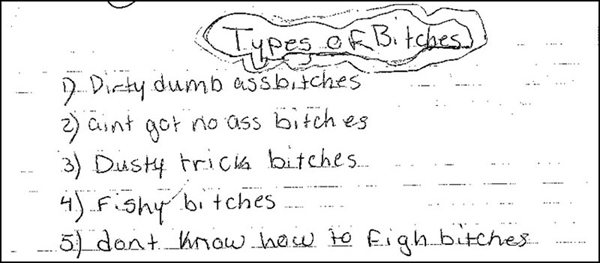
I was just directed to a hilarious post over at 'And I am Not Lying', called 'Types of Bitches', about a list written by third graders at an inner-city Washington DC school, detailing almost 100 types of bitches.

I'm blown away by the ingenuity of whoever wrote this. No way I could come up with that many types of bitches (or most things, for that matter) if I needed to. Clearly, these are kids who are absorbing a ton of language, and remembering it and recombining it at an impressive rate. I think we rarely see written examples of that.

But the real linguistic gem is the blogger's subsequent post, analyzing the comments people (presumably mostly adult, educated people) left on the original post. The blogger and some of the commenters he quotes really seem to get that a language prejudice issue arose out of this.
Stop being so judgemental. Damning her, her values, her upbringing, her likely future is ridiculous. She might be a “reflection of our future” but these are just a few sheets of paper not a manifesto or a clear indicator of a life rife with turmoil.
This is language practice -- a big part of what kids do with words is categorize, recombine -- test it out. It might tell us something about what the author hears a lot, but I don't think it tells us too much else about her. Certainly not that the "kid has issues", as one commenter put it. These are probably really powerful words in this kid's community -- words that let people exclude each other and seem better than each other, for example. What kid wouldn't want to play with that?

7.13.2007

the ascent of aave

aave, or african american vernacular english (a.k.a. black english or ebonics) is a dialect of english most often spoken by african americans. it's often considered to be a substandard version of english, though many have argued for it to be considered a separate language or an equally accepted dialect and view its substandard status as the result of racism and prejudice.

whichever side of this great debate you fall on, you can't dispute what i saw on espn a few days ago. a couple of their shows (i can't keep them straight--i think it was sports center and baseball tonight) feature two to four men talking. the men tend to be of varied ages and races, as we'd probably expect in this day and age. but i'm fairly sure that it's only in the last few years that any commentators have been using aave on the air while sitting behind a desk and wearing suits. one of the young african american hosts especially used some of the hallmarks of aave syntax, such as the possesive 'they' as in, "they offense weak because they quarterback ain't performing." (that's a made-up example. i should have written down what he really said.)

most interesting to me, however, was the mcdonald's commercial that interrupted the show. the final tag line was, "get much love," or, "get much beef," or something. at any rate, it used 'much' to introduce a noun. i can see with with a helping verb as in, "i don't get much beef," or with another modifier as in, "get much more beef," or as the subject of a sentence: "much beef was damaged in the creation of this burger." but as a speaker of standard white english, i don't think the mcdonald's slogan is a construction i would ever use. though i haven't found it in any of the lists of aave syntactic indicators i've consulted, i have an intuition that this is a feature of aave. the only other example i can think of is from sir mix-a-lot's 90's rap, 'baby got back': "little in the middle, but she got much back."

i'm hypothesizing that the use of aave by announcers and in commercials are two sides of the same coin. the acceptability of the dialect in a formal setting (a sports commentary show) is directly linked to its economic utility in commercials. i'm deliberately avoiding saying which one causes the other, because i think that's harder to demonstrate. does the acceptance of aave from announcers prove to networks that it will get their attention in commercials? does the existence of young aave speakers with disposable income motivate advertisers to target them and thus inspire networks to hire aave speakers? consumers, programmers and advertisers are connected in a complicated circuit that i certainly don't understand. the juice that flows through it, though, is certainly money.

i'm hardly saying this is a victory for aave and its proponents. it's important not to confuse commercial viability with other kinds of acceptance. for example, there's a long way to go from sports center to an executive board meeting. but this is a great demonstration of the fact that migrations of language, up or down, are always accompanied by social and economic change. as the dollar goes, so goes the language.

12.11.2006

fake dictionaries

i've been sitting on this one for a while, admittedly, but there are two good reasons to be blogging about the phenomenon that is the fake dictionary genre. the first reason is that i was asked to review one called "mixtionary" by its publsiher, IDW publishing. the second is that i went to a small press book fair in manhattan last weekend (working for coral press www.coralpress.com), and discovered a couple of other prominent fake dictionaries. it occurs to me that the emergence of this genre and its commercial viability probably mean something about our relationship to words. let's see what it is!

the devil's dictionary (view online here) seems like a good place to start, and might be one of the earliest examples of the genre. written by ambrose bierce as a newspaper serial from 1886-1906, it was finally bookified in 1911. a cynical and satirical work, it purports to give the true definitions of common words for "enlightened souls who prefer dry wines to sweet, sense to sentiment, wit to humor and clean English to slang." thus, from the preface, the book is already directed to those who believe there is a right and a wrong way to use language. take, for example, the following entry:
OBSOLETE, adj.
No longer used by the timid. Said chiefly of words. A word which some lexicographer has marked obsolete is ever thereafter an object of dread and loathing to the fool writer, but if it is a good word and has no exact modern equivalent equally good, it is good enough for the good writer. Indeed, a writer's attitude toward "obsolete" words is as true a measure of his literary ability as anything except the character of his work. A dictionary of obsolete and obsolescent words would not only be singularly rich in strong and sweet parts of speech; it would add large possessions to the vocabulary of every competent writer who might not happen to be a competent reader.
as though words could be 'good' based on their aptness of meaning! there clearly seems to be a mindset here that meanings exist in the world, and to best express them we must simply be able to find the words that match.

a newer addition to the true-usage dictionary genre is maggie balistreri's 'evasion english dictionary.' the book is in its fourth printing with melville press, and is a list of trendy, throw-away, and other words the author generally considers useless or even misleading. the dictionary is touted as a mode of cultural critique, but unfortunately written as a personal attack. each definition is written as a statement the speaker might have said instead. for example, one of her ten definitions of 'like' is "I have finished my sentence." the word DOES function this way, and we all understand it to mean this on a daily basis. so why should i buy the book? what's so funny about the fact that 'like' has come to mean something new, and it keeps people from having to say "I have finished my sentence now. Is there anything YOU would like to say?"

the more i think about it, less i know where to start this critique. sure, it's easier to ask "does that make me a bad person?" than "doesn't that make me bad person?" but that's not the fault of any individual speaker, which m.b's rhetoric clearly implies. it also doesn't mean that 'does' MEANS 'doesn't' in any sense of the word 'mean'. and additionally, who says language shouldn't be easier to use? is it lazy or dishonest to ask the question one way rather than the other? is there no room for tact in linguistic prescriptivism? is it even possible to speak completely and literally at all times? watch how i pile up rhetorical questions i'm sure you know my answer to!

both dictionaries wittily point out interesting changes that occur in the language, but the odds that they actually mean anything about our culture are slim to none. there have always been hedge terms. there have always been more or less direct ways to say something. these facts are part of the flow of how language changes. we often abandon words once their meaning becomes too direct and transparent. but this is nothing to be afraid of, and especially nothing to be scornful and superior about.

mixtionary might be a special case, since it defines new, made up words, rather than giving 'true' definitions for words we use falsely. however, its project still has this 'were not using language properly' feel to it, since it seems to be proposing that we need to fill holes in the language. this, however, makes it a cute novelty and not much else.

it's got cartoons of situations in which the new words should be used (which are surprisingly female-centric... almost all of the main characters are women, and there is a disproportionately high number of words about shoes). the words are formed as portmanteau in a, once again, cute but uninventive way (as in 'fleeceo,' fleece + ceo... you can guess what it means). and, to be a nit-picky crossword puzzler for a minute, the words often do not match the definitions in part of speech ('blahtiful = blah + beautiful; a beautiful person who is vapid.')

so the book bills itself (sarcastically?) as "a guide to communicating efficiently in the modern world, in which new-fangled ideas and phenomena leave us at a loss for words." but the idea that anyone might read a book like this and actually adopt a word from it is about as absurd as the idea that people might stop being evasive after reading the evasion english dictionary.

i submit that the fake dictionary genre is intended for people who already care a lot about language and believe that other people don't. it creates a meaning/saying distinction that indicates we need some special training to really understand everyday language. perpetuating this attitude in a joking way strikes me as particularly dangerous, though i'm not sure why. maybe it's because it allows us to discount others' language by believing we know what they mean better than they do. readers can pat themselves on the back for knowing that, though the general public may go on changing language, the literati can always read the truth.

9.11.2006

how to speak and write postmodern

just got this link from a friend, who apparently thought it had my name on it:
how to write and speak postmodern
it's an excellent crash course in how to be a jerk.

but, as another friend says, if anyone can get any mileage out of this, it's invented usage. so i'll just say that postmodernism (poststructuralism, too) gets a bad rap for being so convoluted and buzz-wordy. but these phrases (and the invention of them!) do important theoretical work for the philosophers that use them (although it's true that they will just make you sound pompous if you use them at too many receptions).

for example, a philosopher might choose to use an obscure phrase coined by another philosopher and only understood by philosophy students without explicating it. he might do this, and do it legitimately, to make his own writing less accessible. this can actually be useful, if, for instance, he wants to point to the context of another philosopher's work and use the term in the way the other philosopher used it and ensure that only people who understand this earlier philosopher even bother to tackle his argument. scientific papers often do the same thing when they quote a paper or refer to a school of thought they just don't do it postmodernly (yet).

so the implication is that using the language means you know the background. hopefully the instructions in the article linked above don't ACTUALLY produce coherent-sounding postmodern speak. but all language users run the risk that people aren't using the language according to the conventions we expect.

all jargon, and particularly university jargon, IS exclusive and jerky. it makes academic literature hard to get a foot hold in. it DOES perpetuate the status quo in university teaching because you are more likely to need a professor to help you get that foot hold. but postmodernism is good because it tries to acknowledge these things. and postmodern-speak, if used properly (i mean, according to convention... that was a close one!), is good because it's efficient at acknowledging things. it allows you to say 'yes, i know my speech reflects my education/educational system and european-descended middle-class background; yes i KNOW my use of these terms is contradictory or circular at some level; i'm aware of the arguments of philosophers who wrote on the topic and used these terms; BUT...' all at the same moment that you're starting to engage with the topic and making a further argument, which you obviously consider to be valid and worth talking about or you wouldn't have bothered, given all the above caveats you just made.

now that's an invented usage that packs a whallop!

7.31.2006

deconstruction of a stradivarius

i already devoted a whole post to this article by David Foster Wallace, which appeared in Harper's. as satisfying as writing that was, there is one point, one essential metaphor of Wallace's text, that deserves even more attention.

writes wallace: "A fellow SNOOT I know likes to say that
listening to most people's English feels like watching somebody use a Stradivarius to pound nails."

a wildly descriptive analogy (isn't it?) that serves to illustrate wallace's SNOOTy outlook for the rest of the article. the analogy doesn't just characterize a snoot's logical position, but also the rhetorical and emotional impact of the 'mis'use of language. to introduce such a charged metaphor into what wallace considers a 'logical' argument is to already break down those distinctions (logical vs. rhetorical vs. emotional appeals) to which wallace clings so strongly.

consider the emotional impact of watching someone literally use a stradivarius to pound nails. one would be not only appalled but almost sickened, and certainly justified in trying to stop that clearly destructive action. that is, this use is not just misapplication of an instrument and an unsuccessful endeavor. it also causes the destruction of something finely-wrought by a long-dead master, which, had it been preserved, could have been used by someone else to produce something profoundly beautiful.

it takes a lot of training to properly use a violin, and even more to derive the full benefit of playing an instrument like a strad. there are those, one supposes, who appreciate the music but do not have the education necessary to produce it, but there are apparently others whose ignorance regarding the instrument reveals a ignorance to even the beauty of music.

a stradivarius is a fragile physical object with huge historical significance. to even have access to a strad means having extreme privilege and expertise. the number of such old violins is so limited that even professional recording artists must take excessive precautions when playing them. the VERY wealthy own strads. the poor pound nails.

a SNOOT is one who believes that the voice of an uneducated person is a detriment to language.
they believe that your 'mis'use of language is an infringement upon their ability to use language correctly--not just correctly, but sublimely.
they believe that language is an object that a community shares and should view as a valuable link to the past. if you 'mis'use it, it is significantly, violently and irreparably damaged.
they cannot write the poetry of Keats because you say 'ain't.'

i'm not sure how the idea that language can be damaged got started, but it's very old and often taken for granted. perhaps the snoots feel that the nail pounders should be given an instrument other than language--at least it would be well-applied to the kind of communication 'most people' engage in.

the metaphor, of course, carries intense classist and even racist undertones. the violin and the hammer might as well be symbols of stereotypical leisure and working class activities. the violin is the height of a certain kind of refinement--but only classical european refinement--the only kind that counts. the metaphor calls to mind a savage native trying to bootstrap up to his first use of tools while the european craftsman looks on, disgusted.

doubtless, the snoot utterer, being perfectly in control of language and very well-educated about the consequences of its 'mis'use, knew all this in advance and packed it into the metaphor in question to precisely reveal her own superiority. doubtless wallace quoted it for its concision at debasing those who don't use language as prescribed. kudos to them both. now that's an artful use of language.