Showing posts with label semiotics. Show all posts

3.04.2010

The Language of Signs on Slate

Slate is running a really nice series of articles about signage this week.

Road signs are one of the, well, sign systems that got invented usage started, so I'm excited to see them examined in depth.

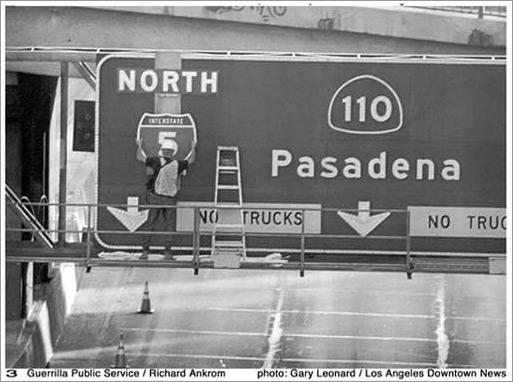
The first part in the series discusses the guy at left, who dressed up as a Caltrans worker and posted his own interstate sign because he was so fed up with the poor signage.

The second part provides an neat tour and analysis of what can go wrong in a poor sign system. I'm also looking forward to part four, about the informal maps we draw each other. These semiotic systems all fall under the heading of 'wayfinding', which is not just about making nice signs, but rather covers the whole science of how people will use signs to find their way. Wayfinding designers consider common use cases and other possible routes users might take -- a lot of the same steps user interface designers go through when planning a web site.

One of the most interesting things about linguistics and semiotics is the fact that people use language systems almost unconsciously (until the systems fail). That's the starting point of the Slate article ('They're the most useful thing you pay no attention to.'), so I'm already on board.

Thanks to Sonia for sending this over.

1.13.2007

|, or a tale of semiotic mystery

i've been seeing this symbol for a few months now: |, and wondering what it is. i've mostly encountered it on facebook, and never took the time to record where it occurred (this post would be a lot better and more professional if i had).

for some reason it struck me as being exceptionally meaningful. it tended to occur in photo captions, and in correspondences (like wall posts) between boyfriends and girlfriends. i, being me, thought 'how cool! people have taken this apparently meaningless symbol, |, and imbued it with all this romantic meaning. it clearly functions as a sign! what a great invented usage. i better blog about that!'

so i set out to discover the root of the meaning of |.

turns out you can't search for punctuation. (this is also the reason i didn't have the guts to title this post simply, '|'.) smilies (:-D) are also unsearchable. and, let's be honest, google is really my only resource for these kinds of things. i was at a loss!

i did try wikipedia's article on internet slang, to no avail, and found this interesting internet-slang-eliminating dictionary, but it proved just as useless in this case.

but then i consulted a friend who is wise in the ways of pop culture. she immediately asked me if i use firefox to view the facebook posts i mentioned above. i do, in fact, use firefox. she informed me that firefox misinterprets a certain piece of internet slang as |. what i should have been seeing was the internet symbol, '< 3', which some browsers and instant messaging programs display as an actual heart: <3. (i suppose that will look like | if you use firefox!)

at first i was a little disappointed that people were sticking to this iconic representation rather than branching out into the more abstract as i'd first assumed. but really, it's pretty interesting that i was able to glean such an accurate idea of its meaning just from the context of the symbol's use. this just goes to show that | could quite plausibly function as a symbol of love. it would just require that readers be exposed to a couple of instances in which they could gather that meaning from context.

this has already happened to '< 3', which doesn't look so much like a heart, and the standard drawn heart that doesn't really look like the anatomical heart, and the anatomical heart that doesn't actually have much connection to love itself. these connections are already conventionally defined and therefore easy to use quickly. but they're conventionally defined nonetheless, the way i thought | was!

score one for the arbitrariness of signs!

12.23.2006

i wanna be a grammatologist.

so, on a personal note, i'm casting about for a career. glamorous unpaid internships beckon, as does linguistics grad school. but my real passion turns out to be completely fictitious. worse than that, it's just a grammatical derivation of 'grammatology'.

'of grammatology' is one of jacques derrida's best known works; it's something like the bible (ahem!) of deconstruction. (i've never gotten through the whole thing, nor, unfortunately, do i have a copy in front of me.) in it, derrida outlines (literally--he sets the boundaries) of a non-science known as grammatology. on the one hand, it's a semiotics--a study of signs. on the other hand, it examines the foundations of the possibility of human knowledge. the tenets of the book never add up to a course of action for a positive science or a philosophy that one could live by. grammatology would always be stuck examining its own foundations in a never-ending self-reflexive mess of critical theory and no one would ever read the whole thing (ahem).

a google search for the term 'grammatologist' asked if i really wanted 'dermatologist,' but i think it's too late for med school. grammatologist returns only 763 hits, but they're some of the most interesting i've encountered.

-most appropriately, in an somewhat clumsy interview, jacques himself explains that there's no such thing as a grammatologist.
-a language log post about the history of the word grammelot and the tediousness of academic review in the blogosphere.
-a post on rhizome.org about a piece of pynchonian net art by mark amerika called 'phon:e:me,' which features a character who 'moonlights as an applied grammatologist' (it can be viewed with firefox, btw).
-and last, but not least, a mysterious message board discussion about martial arts, easter philosophy, and language.

but i think grammatology is more legit than a lot of people who use the term realize. i'm currently applying to a couple of linguistics graduate programs that focus on an phenomena known as 'grammaticization' or 'grammaticalization' (don't worry, linguists, i'm not going to say grammaticization is the same as grammatology!) grammaticization is a process of language change whereby new words and structures form from old bits of linguistic material. a canonical example is 'gonna.' 'going to' used to have a strictly physical meaning, but somehow developed the metaphorical meaning of future or intention. that semantic meaning became phonologically different from the physical 'going to,' which is still used (no one would ever say 'i'm gonna the store'), effectively making 'gonna' a new word or grammatical marker. (i don't really have an adequate grasp of all this yet!)

so, great, grammaticization happens according to certain predictable patterns. what does this have to do with grammatology? well, for semioticians, everything has a grammar. signs don't function as signs (don't convey their intended meaning, let's provisionally say) unless they're properly deployed within a grammatical structure. let's take a fairly literal and real-world example: street signs are a system of signs. they have a syntax--spatial, rather than temporal. the 'stop' sign at the end of my block is turned upside down, so it sort of reads 'pots,' but it still functions as a sign--we still stop at it. however, a friend and i, driving up i-35, saw a truck hauling a sign saying 'NW 63rd street, exit only' across a bridge. we did not interpret that sign to mean that we were approaching 63rd street, because it wasn't within the correct syntactic structure (namely, on a stationary pole over the highway). some errors impair meaning and some don't. if the same 'error' (saying 'gonna' for 'going to') is made over and over, it can enable a new sign to emerge within the same grammatical structure (i wish i could think of an example to apply this to street signs).

if linguists are studying the way new grammatical categories and words and structures form, what if they arrived at a generalizable model for how grammars grow and change? what if we could apply these phenomena of repeated error and re-interpretation to all systems of meaning and explain how totalities form, change, die? wouldn't it be sweet to be a grammatologist?

11.25.2006

"A mere ripple in cow-infested waters"

A moment of Zen, courtesy of analytic philosophy:

"It might still be said, however, that the dependence of cow thoughts on distal cows is assymetrically dependent on their dependence on disjunctions of proximal cow projections; distal cows wouldn't evoke COW tokens but that they project proximal whiffs or glimpses or snaps or crackles or . . . well, or what? Since, after all, cow spotting can be mediated by theory to any extent you like, the barest whiff or glimpse of cow can do the job for an observer who is suitably attuned. Less, indeed, than a whiff or glimpse; a mere ripple of cow-infested waters may suffice to turn the trick."
(Jerry Fodor, "A Theory of Content, II: The Theory," in Stich & Warfield's Mental Representations)

10.24.2006

identity crisis

the identity property is pretty central to a lot of endeavors. if there's one thing our logical proofs, self-congratulatory objectivism and philosophical arguments rest on, it's the fact that "A is A."

of course, this is a perfect example of why traditional logical assumptions and standards shouldn't be applied wholesale to the study of language. in philosophy of language "A is A" is the foundation for the idea that any statement is identical to itself. this works alright for physical objects, but when it comes to language, there are never two identical statements. there are never two identical statements. there are never two identical statements.

the first A is not the same as the second A. in the most trivial sense, they're in different places on the page. they're articulated at different times, drawn slightly differently or pronounced slightly differently. the fact that these types of differences don't count as differences is the most primary function of language. as derrida says, language is repetition and difference. language is, by pretty much anyone's definition, made of repeating elements. but each repetition involves a difference. it's that whole can't-step-in-the-same-river-twice thing.

to say "A is A" is true is not a tautology. it's not a definition handed down by god or a self-evident truth about the universe. it should be seen as a statement of our most basic assumptions about language. assumptions probably isn't even the right word because it's something even stronger than an assumption. it's the nature of language's functioning to flatten out certain differences, especially the differences that context and repetition throw into the works.

i'm not saying "A is A" is not true. it IS true precisely because we understand two separate tokens of the same bit of language (two of the same statement, two "A"s) to be the same thing. and we have this understanding because of the nature of language. and that's a shaky place to build your logic!

10.13.2006

the marked post

today in sociolinguistics, we had a discussion about 'markedness.' the term originated with the prague school of linguistics (generally associated with the structuralist movement), but it seems to parallel useful concepts found in post-structuralist theory. let's explore!

according to the wikipedia article, the linguistic concept of markedness originally referred to certain phonemes that had additional or non-basic features. that is, if schwa (the vowel sound in 'putt') is central, unrounded, etc., it is unmarked in comparison to the vowel sound in 'pete', which is marked for features like 'high.' the same concept has been expanded to syntactic and semantic structures when one is considered more basic or natural.

sociolinguists have found that marked forms are generally associated with more formal discourse. for instance, in english, latin and greek derivatives are more marked than anglo-saxon forms, so 'canine' is more formal than 'dog.' i sense a certain circularity here that i'll return to later.

markedness plays another interesting role in sociolinguistics. in many cases, the unmarked term in a set of opposite terms is also the name of the category that encompasses both of those terms. for instance, 'cow' technically refers to a female bovine. but it can also be used to refer to a group of both cows and bulls. the term 'bull,' on the other hand, can only be used to refer to males, and never to a mixed-gender group. (it's an interesting example, our sociolinguistics professor points out, because it's one of the few gender examples in which the female is the unmarked term.)

in the same way, your height is never referred to as your shortness, no one ever asks 'how slow were you running?' except in extreme cases, and '___ years young' is a kind of joke, because 'height,' 'fast,' and 'old,' are the unmarked terms in their respective binaries.

i'm sure you're asking: what does all this have to do with derrida? well, in the above examples it's fairly trivial to point out that the privileging (unmarking, naturalizing) of one term is arbitrary. it is perpetuated by convention, and goodness knows why it occurs in the first place (that's what sociolinguists try to figure out... good luck, guys). but post-structuralists point out that this also occurs on a more conceptual level. for instance, speech is privileged over writing because it's seen as more natural, older, and because it requires the presence of both speaker and listener (the privileging of speech over writing, besides structuring a lot of philosophical metaphors, is why linguists study speech almost exclusively!). but all the explanatory binaries: naturalness/unnaturalness, purity/impurity, originality/derivation, presence/absence are equally conventional and arbitrary. and linking all the privileged sides of those binaries to each other is also conventional, arbitrary, and empirically untestable. so derrida points out that speech actually has all the impurity, derivation and unnaturalness of writing and that ALL signification is, in this sense, writing.

post-structuralism is often erroneously equated with relativism. undoing all conceptual binaries by demonstrating that they're founded in this linguistic way amounts to relativism only if one believes that language is immaterial. but it can be shown to have real effects in the world. the arbitrary privileging of one half of the writing/speech binary actually determines how we study linguistics. to return to a linguistic example, the difference between saying '21 years old' and '21 years young' is arbitrary, but still meaningful and important.

and i'll just quickly close with my question about markedness and formality: are marked forms more formal, or are formal forms more marked? if markedness develops through conventions of use, these connections can't really be used to predict anything (language change, patterns of reference) except how people will tend to interpret the use of certain terms.

7.25.2006

triangle battle!

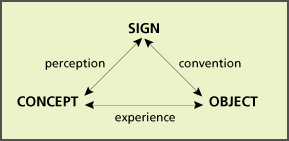
here's a version of the semiotic triangle from seb's last post:
it was made famous by ogden & richards in a 1923 book known as 'the meaning of meaning.' it's important to note that the line along the bottom is dashed and labeled 'an imputed relation,' since symbols can only refer to objects (referents, that which is referred to) through a concept or thought.

here's how ferdinand de saussure, writing slightly earlier, saw the relation between thought and language:
where A is the medium of thought (nebulous, undifferentiated), and B is the medium of language (undifferentiated sound material). the vertical lines are the arbitrary connections between the two media.

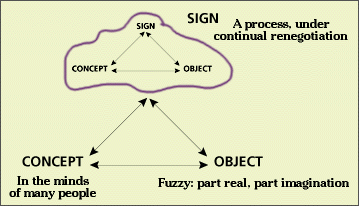
roland barthes, an interesting theorist who bridges the structuralist/post-structuralist gap in the mid-20th century, used this model: i personally like the more specific labels of the relations between the three vertices of the triangle. later, he turned to this image to explain the structure of the 'myth': here, the sign is a more complicated amalgam and the whole process of sign formation/understanding is recursive. (derrida, in particular, is known for his claims about the infinite play of signs and meanings).

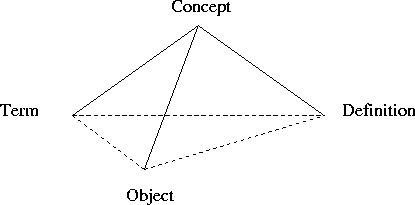
another more recent semiotic triangle is extended to include the term 'definition'. this one is from 1997 and is credited to Suonnuuti, who i've never heard of before. i guess the definition is added based on other conceptual systems or something like that.

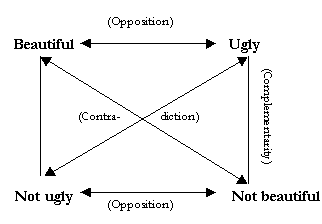
here's what i guess could be called a post-structuralist semiotic schema. it's greimas' semiotic square. it's not actually about the structure of a symbol, but the structure of a particular opposition within a text. remember, post-structuralism isn't a philosophy per se, it's just a way of handling texts and their meanings. in this example, the 'deconstructed' binary is 'beautiful/ugly', and the corners represent (more or less) different positions that characters in a story can occupy or represent.

and here's an epistemological model of the semiotic triangle that i think tries to explain what an artificial intelligence would have to have in order to understand signs: pretty, no? i don't really understand it, but it has the most lines, squiggles, and circles so far!

i guess the point is that these kinds of models are very vague. what lines and circles mean is pretty debatable and not even very empirically useful. also, the value of using a little picture to talk about symbols seems dubious at best to me. these kinds of diagrams only make sense when they're responding to one another, or when one philosopher says 'but what if it did work like this...' and uses an illustration to demonstrate their difference from some other tradition. someone should probably launch a study of these kinds of diagrams as a form in the semiotic/linguistic/cognitive fields. maybe someone already has...

7.17.2006

5.15.2006

quantum language theory

since handing in my paper for 'metaphor and thought' today, i've been able to finally formulate my own metaphor for the great divide in the philosophy of language that's been bouncing around in my head since i watched that 'elegant universe' documentary.

first there was the newtonian theory of physics, which was fairly over-simplified and deterministic. then (to over-simplify a bit myself), along came albert einstein and came up with a much better theory that explained a lot more phenomena and required a major shift in everyone's thinking about the universe. einstein was pretty smart, but toward the end of his life when people started to talk about quantum mechanics, he couldn't handle it. 'gott würfelt nicht,' he said, meaning, 'god doesn't play dice, the laws of nature aren't based on probabilities.'

this is the same position analytic philosophers are in. (i think it's a nice metaphor for them too... they get to be einstein!). they cannot believe there is not a truth 'out there' in the universe to be discovered (i think a lot of philosophers might consider themselves atheists, but i'm just saying... gott might würfle). Their theories work a lot better than older classical models of language, but just try telling a philosopher that reference isn't deterministic, that language doesn't have to have a strict dependence on the world, that the odds determining how a word is used depend on the odds that another word was used two weeks ago and so on..., that vagueness isn't a problem that needs to be solved. you'll get a funny look and a bad grade.

now imagine a contemporary university physics professor who not only doesn't teach quantum physics, but doesn't believe in it. if you told them that light is both a particle and a wave (a very post-structuralist move, by the way!), they would give you a funny look and a bad grade, but then they also might get fired for being 50 years behind the times (unless they had tenure, in which case they might just be ridiculed in the literature and discussed angrily in the cafeteria and department meetings... i don't know how these things work.)

granted, from my understanding, there are more outlandish theories out there (like string theory) that aren't widely accepted or taught in most physics courses. to continue the analogy, i'm not saying philosophy classes should start teaching all the craziest semiotics they can get their hands on. i'm also not saying there's no value to studying analytic philosophy. it's smart, it's interesting, and it maps out a lot of the territory of philosophy of language and shows where the problems are. i'm just saying that philosophy departments and classes exclude out of hand, for no apparent reason other than the fact that it would force them to rethink 100 years of their own research, a huge branch of thought about the same questions they claim to be asking.

some quest for knowledge, huh?

5.06.2006

semantics and the body

I LOVE this book. Semantics and the Body by Horst Ruthrof is the missing link between post-structuralism and linguistics that I've been waiting for.

The author briefly summarizes the history of philosophy of language before really delving into the nitty-gritty of why traditional formal semantics can't handle essential things like negation and metaphor. It's clear he knows his stuff.

While he doesn't buy post-structuralism hook, line and sinker, he does make an important move that is clearly based on literary theory. Instead of beginning with 'normal' language or 'positive' statements and considering meatphor and negation as marginal phenomena that can be described later (as linguists do), he begins with these as things a philosophy of language must account for, and goes on from there.

Ruthrof does buy the claim that everything is textual. That is, in opposition to Lakoff et al., he doesn't think there's some realm of unmediated physical experience that we code into language via metaphor. He believes the body has an essential place in a theory of language because it is a mechanism for interacting with and encoding various perceptual sign systems. It is these non-verbal modes of signification that make ALL linguistic expressions meaningful.

Metaphor, then, simply highlights the play (and the slippage) between the various systems. There is a continuum from metaphor to literal speech that we must negotiate (with varying degrees of uncertainty) every day. This is a pretty elegant theory. It buys a lot of things (for example) a theory of metaphor that meshes with a theory of literal language, without a lot of the explanatory baggage that Lakoff needs to pull along (does each individual's experience shape their metaphorical domains? what is the role of historical change in moving from 'live' to 'dead' metaphors?).

Pay attention, philosophers of language: these divisions (literal/figurative; live/dead; negative/positive) are not as clear cut as formalism would like them to be. Admitting that is the first step toward getting help.